


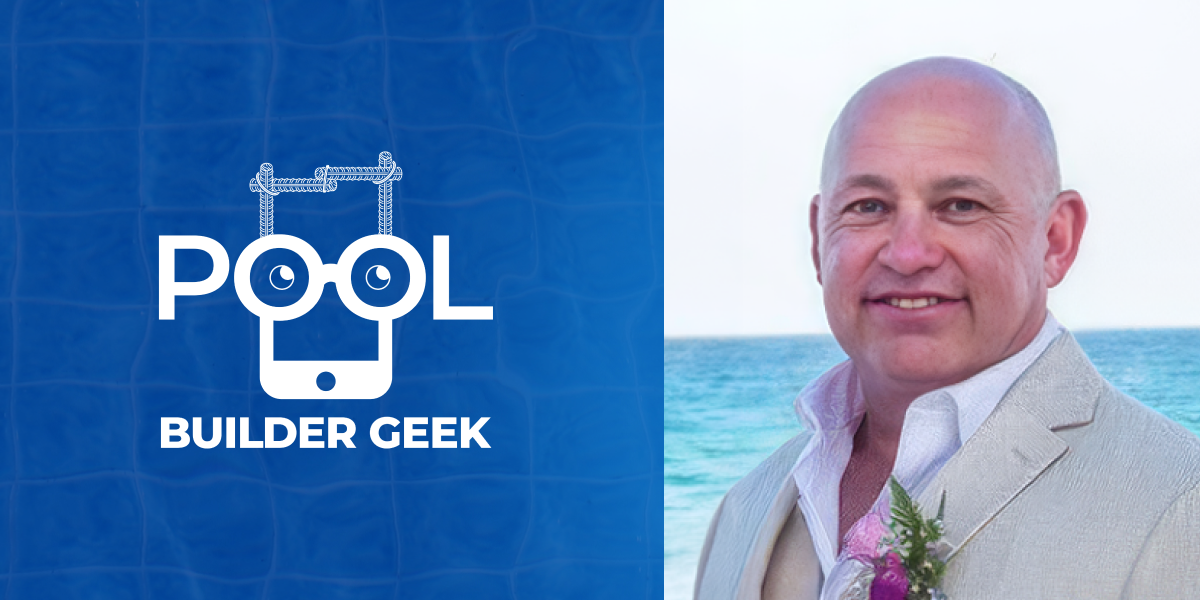
Pool Builder Geek has joined Skimmer, bringing together two platforms built specifically for the pool industry. In this blog, Pool Builder Geek founder, Tommy Reynolds, shares how an unexpected experience building his own pool led him into the industry, what he learned from builders along the way, and why he believes the future of pool software is construction and service working together.
In 2017, I was having a pool built at my house. I had never owned one before, and I knew very little about the industry.
One morning at seven o'clock, the construction crew showed up and started taking down my fence. I had no idea they were coming. My dogs were in the yard, and they did not take it well.
That was my introduction to the pool industry.
Afterward, I asked my builder a pretty simple question: Was there an app that could tell me when someone was going to be at my house if they were here to build something? He said no. I asked whether anything like it existed anywhere in the industry, and he thought perhaps one of the manufacturers had something, but he wasn't certain.
I had spent my career at two SaaS companies building software, so the absence of an app that could solve this problem struck me as unusual. So I started building something myself. At first, it was a nights-and-weekends project: a simple scheduling app that could give homeowners visibility into what was happening at their property. I showed it to my builder. He gave me a few more recommendations and before long, I had built something that could help him schedule work and send his customers updates automatically.
He eventually started showing it to other people. A local service company in town saw it and shared it with a territory sales representative from one of the industry's leading equipment manufacturers, who showed it to his boss. I ended up getting a call from that manufacturer asking whether I would come and meet with them.
I flew to the International Pool and Spa Show in New Orleans and showed them what I had built. By now, this had become Mobile Pool Builder. We signed an exclusivity agreement and launched together at the Southwest Pool and Spa Show in February 2019. Within about three months, we had signed on 50 builders. Later, that manufacturer acquired the company and I spent the next five years working with them. When they eventually decided to move away from software, I started over and built Pool Builder Geek.
What builders are actually struggling with
I've been asking builders the same question for years: what's the biggest problem you face in your business?
The answer is almost always: “communication.”
Builders are managing customer expectations across texts, emails and phone calls, often with no single place to see what has happened and what hasn’t. The process is still surprisingly manual. And when communication depends on someone remembering to send the right message at the right time, the customer experience is only as consistent as the process behind it.
That’s the gap I wanted Pool Builder Geek to solve.
It isn’t just scheduling. It isn't job costing. It isn’t any one feature. The bigger problem is that the conversations, decisions and work happening throughout a pool build have traditionally lived in different places.
So we automated as much of that communication as possible. When work is scheduled in Pool Builder Geek, a notification automatically goes to the subcontractor performing the job and to the homeowner, letting them know what's happening at the property that day.The builder and homeowner can opt out, but communication happens by default.
If that system had existed when I built my pool in 2017, my fence would have come down on a day I actually knew about.
Why pool construction isn't general construction
One of the things people outside this industry often miss is how fast a pool can actually be built. A moderately complex pool can be built in four to six weeks. A house takes months or years.
That distinction matters when you’re building software.
The major construction platforms — Buildertrend, JobTread, Procore — are designed to support a huge range of construction businesses and projects. For a pool builder, that can mean far more software than the job actually requires. The tool becomes something the business has to manage instead of something that makes the work easier.
Our approach has always been different: build for how pool construction actually works.
Pool builders don’t need a scaled-down version of software designed for every type of construction company. They need technology designed for the pace, workflows and customer expectations of this industry.
What AI actually changes
When my own salesman asked what kind of pool I wanted, I told him honestly that I had no idea. I suspect most homeowners are in the same position.
Being able to see the possibilities changes the conversation. That's why, when image generation became good enough, we built visualization into the core of the product rather than treating AI as something to add on later.
The conventional process looked like this: visit the property, take measurements, talk through what the homeowner wants, then go back to the office and send a rendering two or three days later. Every hour in that gap is an opportunity for momentum to disappear.
Now a builder can say "let me show you right now" and generate a visualization of that backyard in seconds. Some designers felt threatened when we first introduced this, and I understand why, but the tool isn't replacing anyone. Think of a paint-by-numbers canvas: the outline is already there, and filling it in is what makes the picture appear. The AI fills in the outline. The designer still does the drawing. The difference is one or two iterations instead of six or seven, and a much faster route to the budget conversation.
Homeowners are already working this way, whether or not builders are. I recently spoke to our local PHTA chapter about how the sales process is changing, and customers are increasingly arriving having already generated images of what they think they want. Their ideas aren't always buildable, which is exactly where the builder's expertise comes in. But the expectation has shifted.
Design is only half of what AI has changed, though.
The other half is how quickly software gets built at all. My team is small and we ship a great deal of code, and AI is a large part of why. Features that would once have taken a quarter now take weeks, so when a builder calls me with an idea, I can often get it in front of them while the conversation is still fresh.
And that same acceleration is already reshaping software across the pool industry. Vibe-coded pool apps are appearing constantly. Some of them are genuinely clever, and they exist because someone saw a problem on a job site and built something over a weekend.
But building something quickly and running it reliably for thousands of businesses are two different things entirely. Speed can get a product to market, but scale requires the infrastructure to support it. You need reliable customer support, strong security, durable integrations, and uptime businesses can depend on. That’s the part most of these tools will never reach, because it takes years and significant investment to build.
Which brings me to why I'm writing this at all.
Why Skimmer
My original vision was never limited to construction.
I imagined one environment that the whole industry could work within: builders, service professionals, the trades, and eventually the homeowner. I built the construction side independently because it was a problem I knew needed solving, but construction was only one part of the bigger picture.
At the same time, my customers kept asking me about service and maintenance. And I had been watching Skimmer build on that side of the industry for roughly as long as I had been working on construction.
When I met Jack and we compared our visions, the overlap was obvious. We were both working toward a more connected way to run a pool business, just from different starting points. At some point, it became clear that our paths should come together. That’s why I've joined Skimmer to lead the construction side of the business, and Pool Builder Geek is now part of it.
I still think about a conversation I had with Jeff Ast from Shasta Pools back in 2020. He told me: "Tommy, you know what I want? One piece of software that does it all. My designers design it, we estimate and price it, my construction team produces it. I just want one thing. Is that too much to ask for?"
I told him I didn't think so. Six years later, I think we're getting there.
What I want our customers to know
Everything in Pool Builder Geek was inspired by a pool builder somewhere. When a customer comes to me with an idea, my first question usually is: "How do you think it should work? Walk me through it." That direct connection with the people using the product has always guided our vision from the beginning, and shaped what we’ve built. That doesn’t change.
The service, the commitment and the investment in our customers’ businesses are all still here. What changes is how much we can put behind them.
By becoming part of Skimmer, we have more resources to build, improve and support the product while staying focused on the problems pool builders actually need us to solve.
Where this goes
A pool gets built once and then serviced for the next 20 or 30 years. The industry has long treated those as two separate businesses requiring two separate sets of tools, and has organized itself accordingly.
But a great many service companies also build, and a great many builders also service. That separation was never real for them. It was only ever real in the software.
That’s what really makes this next chapter so interesting to me.
Manufacturers play an essential role in this industry, but their products primarily live on the equipment pad. Software like Skimmer and Pool Builder Geek get to live inside the business itself: in the scheduling, estimating, customer communication, construction workflows and service operations that determine how efficiently a pool company runs and how well it grows.
Bringing those pieces closer together gives us an opportunity to build something the industry has needed for a long time: technology that follows the pool business across its entire lifecycle.
That’s the opportunity I saw when I first started building software for this industry. And that’s why I’m excited about what we can build next.
About Tommy Reynolds:
Tommy Reynolds is a Houston-based software founder focused on building technology around real-world operational problems. He’s known for a high-effort, go-get-it mentality and a willingness to do the tough thing. Putting the customer first has shaped every company he’s been a part of. His career has spanned payments, sports technology and pool industry software, including early roles at Retriever Payment Systems and Orion Payment Systems, then founding SportsCRM (a SaaS product for sports organizations) and AVCA VPI (later sold to AVCA). His work in pool software began after having a pool built in his own home and seeing firsthand the communication gaps between the office, subcontractors and homeowners. He went on to build Mobile Pool Builder, which was acquired by a leading pool equipment manufacturer, before founding Pool Builder Geek. Reynolds has now joined Skimmer to lead their construction strategy, helping bring construction and service together for pool professionals.
Read more about the acquisition: Skimmer expands into pool construction software with acquisitions of Pool Builder Geek and Poologics.


