


Ask most pool pros what they're best at, and marketing won't come up. Water chemistry, routing, customer relationships built over years of showing up on time — that's the craft. Marketing gets squeezed in around it, if it happens at all.
There are only so many hours in a service day, and the ones spent on marketing don't show up on an invoice. Marketing becomes a thing that just happens when there's time. In a seasonal, route-heavy business, that extra time is rare.
Here's the problem with that trade-off: the pool companies pulling ahead right now aren't necessarily the ones spending the most on marketing. They're the ones who've made marketing repeatable — something that runs whether or not the owner remembered to think about it that week. Coordinated, not occasional.
That distinction plays out differently depending on where a company is starting from. See if one of these sounds familiar.
No real marketing at all
For a lot of pool companies, growth still runs almost entirely on word of mouth or remembering to ask a pool owner for a Google review. There's no system for staying in front of past customers once the season ends, no consistent way to turn a good job into a five-star review, no outreach when a customer goes quiet.
It works, until it doesn't. The cost shows up as churn nobody saw coming and a growth rate capped by how fast word travels in a neighborhood. The company isn't losing customers because service is bad. It's losing them because nothing was in place to keep the relationship warm.
Marketing that happens, sometimes
Other companies are doing something: a review request here, a promotional email there, usually sent manually, and usually inconsistent. It falls off exactly when it matters most: during the summer rush, when there's no time left for anything that isn't a route or a work order.
The frustrating part? The effort isn't wasted, it's just not compounding. A one-off email campaign in April doesn't build on itself. Without a system running in the background, marketing stays a task on an ever-growing to-do list instead of an asset that works for you to grow the business.
Marketing running across multiple disconnected tools
Larger companies tend to have the opposite problem: marketing exists, but it's scattered. Email lives in one tool, another tool tracks reviews, and reporting happens in a spreadsheet somebody updates when they get to it. There's no single view of what's actually working, no easy way to prove the spend is paying off, and no consistency across service locations or teams running their own version of "marketing."
The cost here isn't inaction, it's waste. Money and time go into a function that's hard to manage and even harder to hold accountable, because no one has one place to look.
The common thread
Three different starting points, one shared root cause: marketing that depends on someone remembering to do it, rather than a system built to do it consistently. Whether that's an owner who never got around to setting anything up, a manager whose good habits slip during busy season, or a company running five disconnected tools with no shared view — the fix isn't more effort. It's coordination, connecting separate tools, and eliminating manual work.
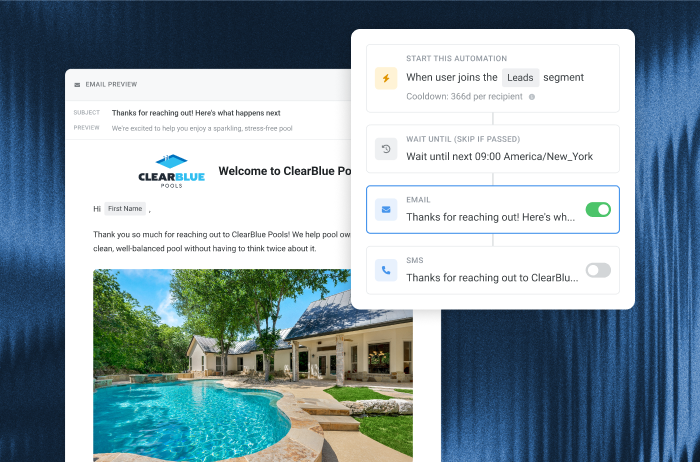
Coordinated marketing means the reviews, the outreach, and the reporting all live in one system that runs on its own. It means a customer who hasn't been serviced in six months gets a check-in without anyone having to remember to send it. It means every completed job has a shot at becoming a five-star review, automatically, instead of relying on someone to ask. And it means one dashboard showing what's working, instead of stitching the story together across four different logins.
None of that requires becoming a marketing company or hiring a marketing specialist. It requires making sure the good work already happening — the service that earns repeat customers and referrals in the first place — actually gets seen, remembered, and repeated.
Where Skimmer Marketing Suite closes the gaps
We built Marketing Suite to close exactly this gap. Not a new tool to learn and manage on the side, but marketing that runs inside the system pool pros are already using to run routes, send invoices, and track customer records.
For the company with no marketing in place, it's ready to turn on: campaigns and review requests that go out without a setup project or a marketing hire. For the company doing marketing manually and inconsistently, it's the automation that keeps outreach and review requests running through the busy season, without anyone having to remember. For the company juggling disconnected tools, it's campaigns and reviews in one place, with one reporting view — a single source of truth instead of four.
However your company is currently approaching marketing — none at all, some but inconsistent, or scattered across too many tools — it's worth a look at what happens when it runs as one connected system instead of a collection of good intentions.


