


FAQs
Can I really grow revenue without adding more pools to my route?
Yes, and a growing number of pool pros are doing exactly that. The 2026 State of Pool Service report found that 24% of owners are reducing their customer count to improve per-pool profitability. Revenue quality matters more than volume. Raising rates, switching chemical billing models, capturing repair work, and tightening up invoicing can all increase what you earn from the route you already run.
How much should I raise my rates?
Most pool service owners keep planned rate increases at 10% or less, according to the 2026 State of Pool Service report. That's generally enough to offset rising costs without triggering significant pushback, especially when the increase is communicated clearly and in advance. Skimmer's price increase toolkit includes a calculator to help you find the right number for your business.
What's the difference between a plus-chems model and a hybrid model?
A plus-chems model bills all chemicals separately from the monthly service rate. A hybrid model includes some chemicals in the base price while billing others as line items. Both approaches give you more protection against volatile chemical costs than a fully included model. Which one works best depends on your market, your customer base, and how you want to structure your invoicing. Skimmer's blog post Is a service plus chems pricing model right for you? walks through the tradeoffs in detail.
How do I know which accounts to drop?
Start with your cost data. Pull per-pool profitability in Skimmer's profit report and compare what it costs to service each account against what you're collecting. Chemical-heavy pools on included-chem contracts, accounts that require frequent callbacks, and stops that consistently push your tech behind schedule are worth evaluating. The pool service break-even analysis calculator can help you understand the financial floor before you make any decisions.
How does service documentation actually reduce churn?
Customers who feel ignored or uncertain about the quality of work are the most likely to leave. Sending a service report after every stop, with chemical readings, photos, and completed checklist items, gives customers consistent, visible proof that the work was done correctly. It reduces disputes and builds the kind of trust that makes customers far less likely to respond to a competitor's pitch. Skimmer's pool service agreement toolkit helps set those expectations from day one.
What does Skimmer's AI Phone actually do?
Skimmer's AI Phone answers inbound calls when you're unavailable. It's trained on pool service scenarios and can handle new customer inquiries, repair requests, and billing questions. When an unknown caller contacts you, it automatically creates a lead record in Skimmer with a log of the call attached. Existing customers are recognized by phone number, and you can set transfer rules so different call types route to the right person on your team. A 30-day free trial is available.
Key takeaways
- According to the 2026 State of Pool Service report, 61% of pool service owners are prioritizing internal efficiency over adding new accounts, and 24% are actively cutting low-margin customers to improve per-pool profitability.
- Revenue growth doesn't always require a bigger route. Raising rates before busy season, shifting to a plus-chems or hybrid billing model, and capturing every chemical as a line item are practical ways to protect and grow margins without adding overhead.
- Repairs and renovation work carry significantly higher margins than routine service (30% to 60% versus 15% to 40%) and can be built into stops you're already making.
- Missed charges and manual billing errors are among the most consistent sources of margin erosion in the industry, and they're largely preventable with automated invoicing and billing systems.
- Dropping unprofitable accounts frees up capacity for higher-value work and often improves overall route profitability.
- Consistent service documentation reduces churn by giving customers visible proof of quality after every stop.
- For busy season specifically, tools like Skimmer's AI Phone close the gap between a missed call and a lost job.
##TOC##
##Key takeaways##
Adding more stops sounds like the obvious path to higher revenue. More pools = more income.
The math seems straightforward, but in practice, it's more complicated than that. During busy season especially, every extra stop adds pressure: more windshield time, more chemical spend, more coordination, and more potential for something to go wrong. When margins are thin, packing on volume can actually make things worse.
The pool service businesses gaining ground right now aren't all running bigger routes. According to the 2026 State of Pool Service report, 61% of owners are focused on internal efficiencies, and 24% are actively reducing their customer count to improve per-pool profitability. Growth is shifting from "more pools" to "better revenue per stop."
Here are seven ways to make that shift.
Raise rates
Many pool pros leave money on the table by holding rates flat year after year, while chemical costs, fuel, insurance, and labor keep increasing. That said, The State of Pool Service report shows that planned price increases of 10% or less are most effective, since they’re modest enough that well-prepared customers accept them and meaningful enough to protect your margins.
The key is timing and communication. Announcing rate adjustments before peak season, with a clear start date and a grounded explanation, removes most of the friction. Customers who feel informed are far less likely to push back than customers who feel surprised. Skimmer's price increase toolkit includes a calculator and ready-to-use templates to take the guesswork out of the process, and the free price increase email template gives you a starting point for customer communication. For a deeper look at the math behind pricing decisions, the blog post How to price pool services to maximize profits walks through the full analysis.

Switch to a plus-chems or hybrid billing model
When chemicals are included in a monthly rate and costs spike, your margins absorb the hit with no recourse. Shifting to plus-chems or hybrid billing can help soften the impact of some of the more volatile costs, and it doesn't require raising your base service rate.
According to the State of Pool Service report, 30% of pool pros now bill chemicals as separate line items, and another 25% use a hybrid model that separates some chemicals while bundling others. Tracking chemical usage per pool and itemizing it clearly on invoices gives customers a clear picture of what they're paying for, and it gives you the data to have an informed conversation with any customer who pushes back. If you’re curious about shifting to a plus chems or even a hybrid model, the Chemical Spend System for Field Teams is a free spreadsheet built specifically for tracking chemical spend across your route. Plus, Skimmer’s blog post Is a service plus chems pricing model right for you? covers real-world implementation from pool pros who've made the switch, including how Skimmer handles the billing structure natively.

Build repair and renovation work into your existing route
42 percent of pool service owners plan to expand into repairs, renovations, builds, or other service lines in 2026. The opportunity is real, and for most pool pros, it's already sitting in their existing route. Every aging pool on your weekly schedule is a potential repair or equipment upgrade job. Filters, heaters, automation systems, and surfaces don't last forever, and because you're on site each week, you see what's deteriorating long before the customer does.
The most effective way to capture that work is to build a simple process for noting repair opportunities during routine service, then follow up with a quote before the customer finds someone else. Repairs also carry significantly higher margins than routine service, running 30% to 60% for repair work compared to 15% to 40% for weekly maintenance, according to Skimmer's blog post Breaking into pool repairs and high-margin services. Skimmer's quotes feature also lets techs capture and send quotes directly from the field without a separate site visit, and for larger jobs where cost is a barrier, consumer financing gives customers a monthly payment option while you get paid in full immediately, and our repair pricing calculator helps you build quotes on real numbers before you send anything to a customer.
Stop losing revenue to missed charges and billing gaps
Missed charges are a margin problem that compounds quietly over time. A forgotten chemical dosage here, an unreported work order there; across a full route, those gaps add up fast. The 2026 State of Pool Service report identifies missed charges and manual billing errors as some of the most consistent sources of margin erosion, and they're largely preventable with the right systems in place.
Automated invoicing tied directly to completed service and chemical dosages removes the manual step where most mistakes happen. When billing pulls from what was actually done on a stop, nothing gets left off the invoice. Setting up recurring invoices for monthly service customers and enrolling them in autopay eliminates payment delays without any additional follow-up.
The blog post How pool service software helps you maintain a healthy cash flow and grow revenue goes deep on how reporting features, including the profit report and sales-by-category report, help you identify where revenue is slipping. If you're moving customers off check or cash, Skimmer's go cashless email template gives you a ready-to-send message to make that transition smooth.

Drop your lowest-margin accounts
This one requires discipline, but 24% of pool service owners are already doing it. Identifying and removing unprofitable accounts isn't about shrinking the business. It's about reclaiming time and capacity that's currently being burned on accounts that cost more to service than they return. Chemical-heavy pools on included-chem contracts, stops that routinely require callbacks, accounts that generate disputes or push your techs behind schedule — these are the accounts worth a hard look.
Pulling per-pool cost data and comparing it against what you're collecting often surfaces a handful of accounts that are quietly dragging down margins across the whole route. Removing them frees up capacity to replace them with better customers, or simply recover time that's worth more than the stop. The pool service break-even analysis calculator helps you understand exactly how many accounts you need to cover your costs, which makes it easier to evaluate which ones to keep. The blog post Strategies for increasing revenue without adding more pools walks through how owners use Skimmer's profitability reports to find and act on problem accounts.

Capture every chemical and product as a line item
Even if you're not ready to move to a full plus-chems model, tracking chemical usage per pool as if you were paying for it separately changes how you see your margins. Companies that bill chemicals separately already know which pools consume above average, and that information tells you which accounts are costing you money under an included-chem structure, which customers should be on a different pricing plan, and where to have a direct conversation about billing.
Treating chemical tracking as a cost-accounting function rather than a service record gives you the visibility to make better pricing decisions over time. The Chemical Spend System for Field Teams makes tracking straightforward across the whole team. Skimmer's chemical dosage report, covered in our cash flow and revenue blog post, shows chemical spend by tech, customer, month, or year, and flags exactly where costs are running ahead of what you're charging.
Use service documentation to protect existing revenue
Customer churn compounds fast in a route-based business, and the reasons customers leave are usually the same two things: they feel ignored, or they lose confidence in the quality of the work. Both are preventable with consistent service communication. Sending a service report after every stop, with chemical readings, completed checklist items, and photos, gives customers visible proof that the work was done and done correctly. It answers questions before they become complaints, and it reduces the disputes that erode trust and, eventually, the relationship.
Customers who can see the full service record are less likely to question the invoice and less likely to switch providers when a competitor knocks on the door. Skimmer's pool service agreement toolkit helps set clear expectations from day one, which is one of the most effective ways to prevent churn before it starts.
Bonus tip: Let AI answer the phone when you're on a route
Okay, so technically this one is about adding routes, but we'd be remiss if we didn't mention it. Every missed call during peak season is a potential repair job, a new customer inquiry, or an existing customer who'll call a competitor next.
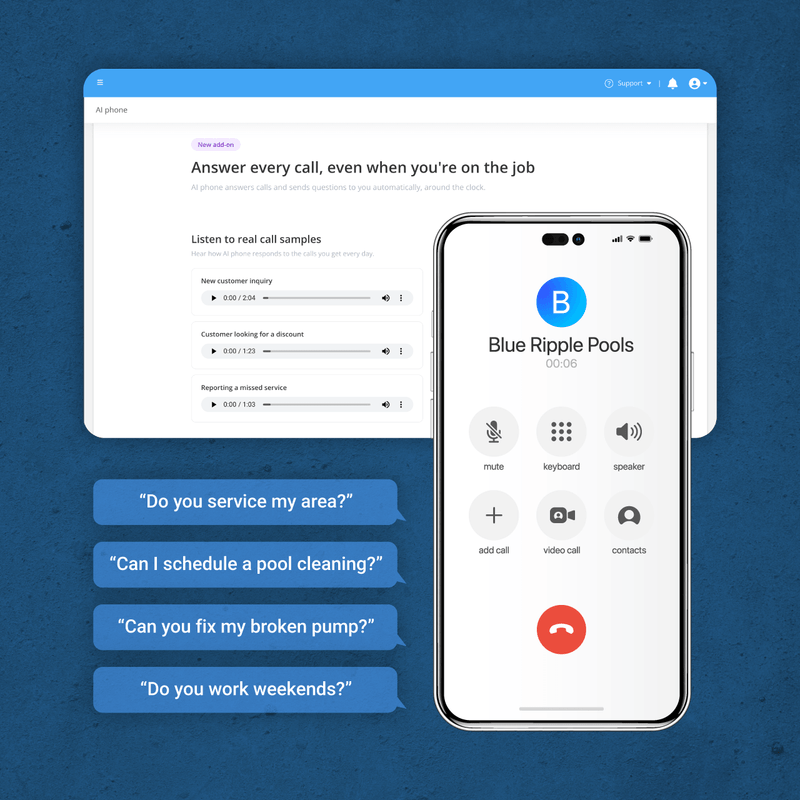
Skimmer's AI phone handles inbound calls when you're unavailable, whether you're mid-route, after hours, or heads-down on a job. It's trained on pool service scenarios and can handle new customer inquiries, repair requests, and billing questions with enough context to be genuinely useful. When an unknown caller contacts you, AI phone automatically creates a new lead record in Skimmer with a log of the call attached. Existing customers are recognized by their phone number, and you can set transfer rules so specific call types route to the right person on your team. Your actual number doesn't change; setup involves forwarding calls to the Skimmer-provided number. It won't replace a full-time office manager, but it closes the gap between a missed call and a lost job during the months when that gap costs the most.
If you want to try it out, a 30-day free trial is also available.
The bottom line
Revenue quality matters more than volume. The pool service businesses growing with less friction right now aren't all running the most stops. They're capturing more of what they're already earning, pricing their work accurately, and building services that generate higher-margin work from customers they already have.


