Everything you need to buy or sell a pool route the right way — contracts, calculators, checklists, and expert guidance. All in one place. All free.





Most pool service professionals underestimate the complexity of a route transaction. The primary asset isn't trucks or equipment — it's goodwill. The trust and loyalty a seller has built with their customers over years. That's what you're paying for, and that's what you need to protect.
Routes typically sell for 6–12× monthly service revenue. A route doing $10,000/month could be priced anywhere from $60,000 to $120,000 depending on density, customer data quality, equipment condition, and pricing structure. Without the right tools, that math is easy to get wrong — in either direction.
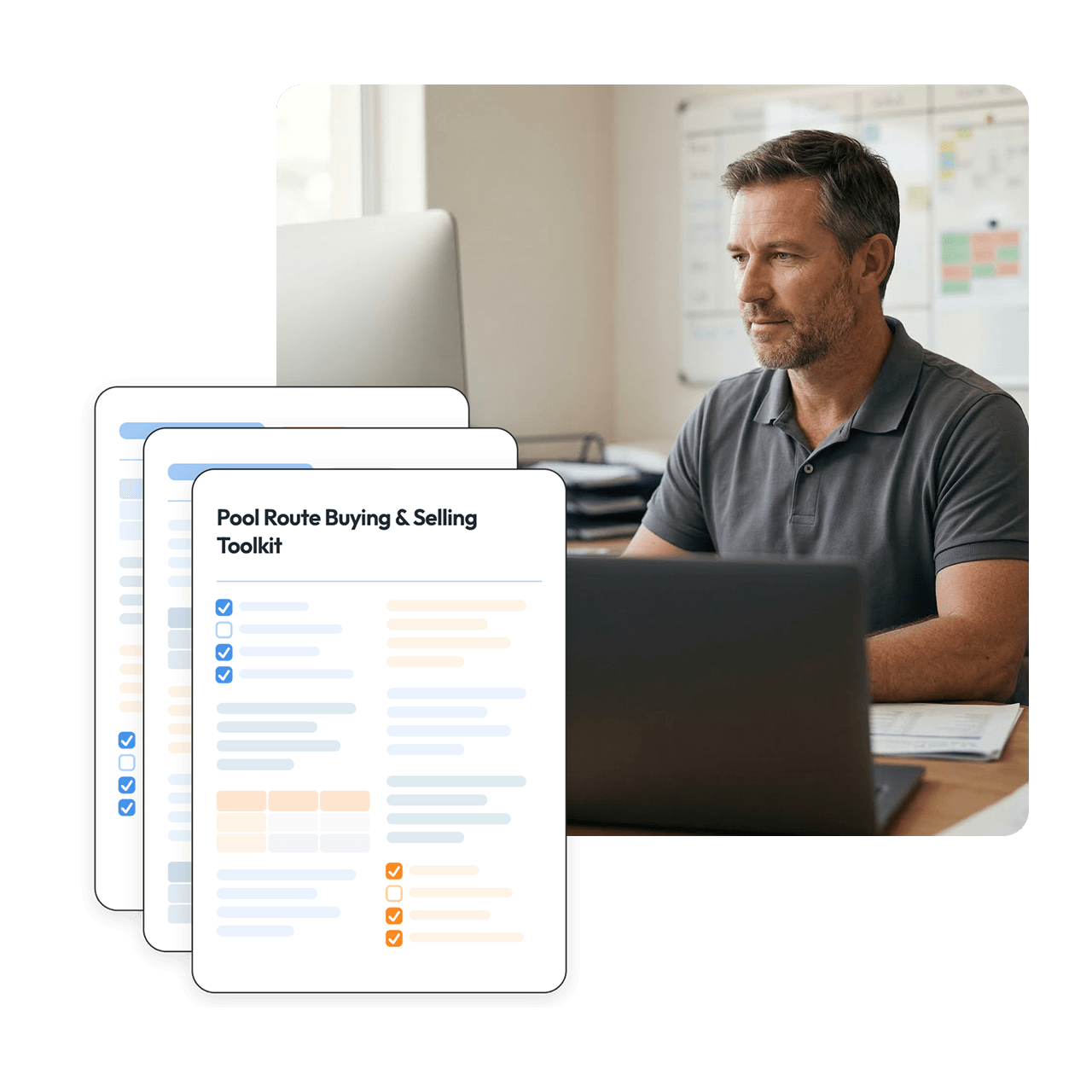
This toolkit gives buyers and sellers the templates, frameworks, and financial models to execute a clean, well-documented deal and a transition that retains customers.
Every document in this kit reflects how deals actually get done in the pool service industry — from the contract language that protects both parties to the 90-day onboarding checklist that keeps customers from walking.
From first outreach to post-close retention, this toolkit follows the transaction from valuation through transition. Nothing is left to improvise.
The frameworks here are drawn from pool pros who have successfully bought and grown businesses through acquisition — including insight from operators who've built scale specifically through route purchases.
Whether you're acquiring your first route or offloading a book of accounts after years in the business, this toolkit has purpose-built resources for both sides of the table.
📄 Pool route acquisition transition letter — seller A professionally worded customer communication template for sellers to announce the ownership change and introduce the new company. A warm handoff is one of the highest-leverage steps for customer retention.
📄 Pool route acquisition transition letter — buyer A follow-up welcome letter template for buyers to introduce themselves, confirm service schedules, and set expectations on billing and communication. First impressions with inherited customers matter.
📄 Sample pool route acquisition contract & non-solicitation agreement A complete example purchase agreement including a bill of sale, account exhibit, guarantee terms, holdback structure, and non-solicit/non-compete clauses. Please review with a licensed attorney before use.
✅ Pool route due diligence checklist A structured pre-close checklist covering account verification, pool and equipment inspection, territory mapping, rate review, and seller profile assessment. No serious buyer should skip this step.
📊 Pool route acquisition ROI calculator A financial model built for route valuation. Run payback period scenarios at different multiples and margin assumptions, model attrition risk, and stress-test your deal before you commit.
🎥 Webinar: Route to success — strategies & considerations for buying and selling pool routes A recorded expert session covering valuation, deal structure, transition strategy, and the most common mistakes buyers and sellers make. Practical and specific to the pool service industry. Watch the webinar →
🎙️ Podcast: Building a valuable pool service company with Casey Graham A candid conversation about what it takes to build a pool service business worth buying — or worth growing through acquisition. Covers pricing architecture, retention, and what buyers are actually looking for. Listen to the episode →
💬 Skimmer community: Buying & selling routes channel Connect with pool pros actively buying and selling routes. Ask questions, share deals, and tap into the experience of operators who've been through the process. Many of the best route deals happen through relationships built here before anything is ever listed publicly. Join the conversation →
Step 1 — Get your bearings Start with the blog guide and the webinar. Understand what a route is actually worth, what drives the multiple, and what the deal structure should look like before you talk numbers with anyone.
Step 2 — Run your numbers Open the ROI calculator and model your specific deal. Use service-only revenue for your baseline. Test sensitivity at different attrition rates. Know your payback period before you make an offer.
Step 3 — Work the checklist Before any money moves, complete the due diligence checklist. Walk pools, verify accounts, map the territory, and review billing history. The deals that go sideways are almost always the ones that skipped this step.
Step 4 — Execute the contract Use the sample agreement as a reference for structuring your deal. Make sure the account exhibit is complete, the guarantee period is defined, and the non-solicitation terms are clear. Get an attorney to review it.
Step 5 — Manage the handoff Send the seller letter first. Follow with the buyer welcome. Move customers to autopay and digital invoicing in the first 30 days. Audit account profitability in days 31–60. Begin pricing adjustments at or after the 6-month mark, backed by data.
How much does a pool route typically sell for?
Across the industry, routes generally sell for 6–12× monthly service revenue, with repairs excluded from that calculation. The multiple varies based on customer density, data quality, equipment condition, pricing structure, and the seller's profile. A retiring owner with long-tenured customers tends to command a higher multiple than a seller offloading problem accounts.
What's the biggest mistake buyers make?
Skipping structured due diligence. Verifying that every listed account is real, billable, and geographically practical takes time — but it's the step that separates a good acquisition from an expensive one. Use the checklist.
Do I need a broker to buy or sell a route?
No, but it helps for first-time buyers. Brokers add process, escrow, and account verification. Experienced operators often transact privately through community relationships and platforms like The Pool Deck. The sample contract in this toolkit is designed to support direct deals.
What financing options are available for buyers?
Because goodwill doesn't serve as traditional collateral, buyers typically explore SBA loans (for operators with documented revenue), seller financing, home-equity lines, or broker-assisted structures. The right option depends on your financial position and the size of the deal.
How do I retain customers after the acquisition?
The two-step introduction process works: seller sends first, buyer follows up. Move accounts to autopay early, deliver consistent service from day one, and wait at least six months before implementing pricing changes. Attrition of 5–20% in the first 90 days is common — a proactive communication plan reduces it significantly.
Is this toolkit really free?
Yes. No purchase required, no trial to sign up for. Download it, use it, share it with other operators.