


FAQs
What tasks are pool pros using AI for right now?
The most common early use cases are writing and communication tasks: drafting customer emails, rate increase letters, staff policy documents, and social media content. Route optimization assistance has also gained traction, helping owners map service routes faster. These are areas where AI produces a draft that a human reviews before anything goes out, which makes the risk low and the time saving real.
What are pool service owners most concerned about when it comes to AI?
The concerns are operational, not philosophical. Owners want to know whether a tool will actually work reliably, whether it will confuse customers, and whether their staff will adopt it. Cost and pricing transparency, data privacy, and the risk of errors in billing or customer communication are the most commonly cited issues. These are the same questions owners ask about any new tool.
Should I trust AI to handle invoicing and payments?
The 2026 State of Pool Service Report data suggests caution here. Forty percent of owners say they'd never trust AI to fully handle invoicing and payments. That said, there's an important distinction between AI making billing decisions autonomously and AI helping you move faster through billing workflows: flagging overdue accounts, automating reminders, and surfacing issues for a human to review. The second model is where most of the practical value lives right now.
How is AI changing pool service marketing?
AI is reducing the time it takes to produce drafts of social content, email campaigns, and website copy. The limitation is quality control: AI-generated content tends toward generic phrasing and off-brand tone if it isn't reviewed carefully. Industry marketing professionals are consistent in saying that AI works best as a drafting tool, not a publishing tool. Human review before anything goes out is not optional.
How should a pool service business get started with AI?
Start with low-risk tasks you'd review anyway, like drafting customer communications or summarizing service notes. Layer AI into workflows you already have rather than building around it. Keep humans in the loop on billing, quoting, and customer-facing communication until you have confidence in how a tool handles edge cases. Set clear parameters for what AI can and can't do before you expand use, and train your staff with a brief walkthrough on how to write effective prompts. Most AI errors in small business settings come from vague instructions, not from the technology itself.
Is AI relevant for solo operators and very small pool service companies?
Research suggests the belief that AI isn't applicable to small or solo operations is primarily an education gap rather than a real limitation. The use cases exist at every business size. The challenge for very small operators is that they often don't have anyone helping them find and evaluate new tools. Starting with a single, narrow task and measuring the result over 60 to 90 days is a practical approach regardless of company size.
Key takeaways
- 2026 is the first year the pool service industry has structured data on AI attitudes. Nearly 60% of owners show at least moderate intent to invest in AI-driven tools in the next 12 months.
- The tasks where owners most want AI help are invoicing, route management, overdue invoice follow-up, and customer communication — all high-repetition, time-consuming work.
- Pool pros are drawing firm lines around autonomous AI use in revenue-critical tasks. Forty percent say they'd never trust AI to fully handle invoicing and payments; 28% feel the same about quotes and estimates.
- The use cases gaining the most real-world traction are writing and communication tasks: drafting customer responses, rate increase letters, policy documents, and social media content.
- Most AI mistakes in small business settings trace back to unclear instructions or rushed use, not technology failure. Training staff to use AI tools properly is as important as choosing the right tool.
- Some owner resistance may reflect a definitional confusion between "AI as autonomous agent" and "AI as workflow assistant." These are meaningfully different propositions with different risk profiles.
- The owners getting the most value from AI right now started with a narrow use case, kept humans reviewing output before it went anywhere, and built from there.

##TOC##
##Key takeaways##
A lot has been written about AI changing every industry. Most of it overpromises. In pool service, the reality is more grounded: owners are paying attention, asking reasonable questions, and moving carefully. That's not reluctance; it's how professionals who run tight operations have always evaluated new tools.
2026 is the first year the pool service industry has structured data on how owners actually view AI, and the picture it reveals is worth taking seriously. This article draws on Skimmer's 2026 State of Pool Service Report, real owner voices, and broader small business data to give you an honest read on where the industry stands.
The broader context: AI is growing fast, including in small business
Pool pros don't exist in a technology vacuum. Across small businesses generally, AI adoption has accelerated sharply. Generative AI usage among small businesses jumped from roughly 40% in 2024 to 58% in 2025, with 76% of small businesses either actively using AI or exploring it, according to U.S. Chamber of Commerce data compiled by AdAI Research.
The Federal Reserve's own monitoring of U.S. AI adoption puts overall business adoption at about 18% of firms at the end of 2025, with more than 20% of firms expecting to use AI in the first half of 2026. Work-related generative AI adoption among individuals stands at roughly 41% of the workforce as of late 2025.
The more useful number, though, comes from research examining what "adoption" actually means. Most small businesses are in what researchers call the exploration phase: individual employees trying tools on their own, usually without a company policy and rarely with any structured plan. That's not adoption in any meaningful strategic sense. It's unstructured experimentation that shows up in survey data as “use”.
Pool pros reflect this pattern closely. Interest is real, but so is the gap between "tried it once" and "built it into how we run."
What the 2026 State of Pool Service Report actually says
The report offers the first structured look at how pool service business owners are thinking about AI, and the data is clear on a few things.
Investment intent is genuinely positive. Nearly 60% of owners show at least moderate intent to invest in AI-driven tools in the next 12 months: 21% are very likely, 17% are likely, and another 21% are somewhat likely.
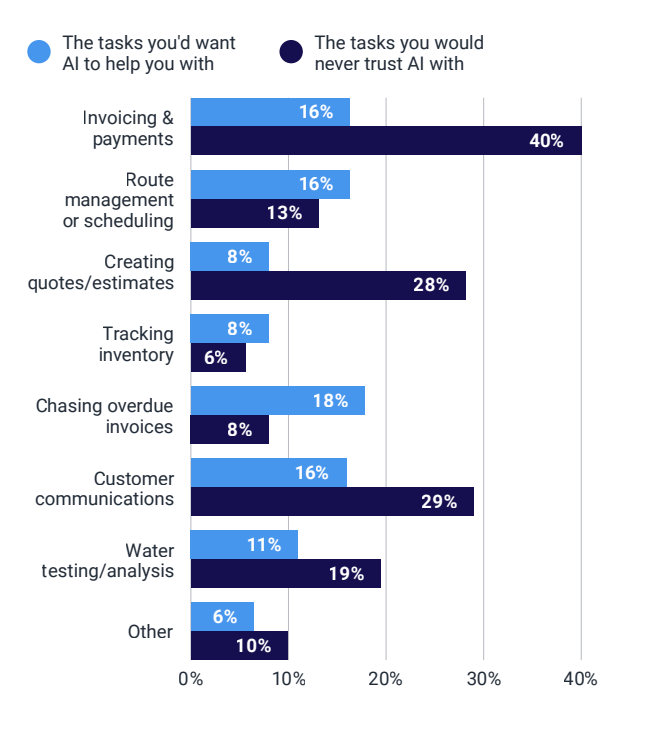
The tasks where owners most want help are predictable and practical: invoicing and payments, route management and scheduling, chasing overdue invoices, and customer communication. These are the administrative pressure points that absorb time every single week, and they're the areas where pool pros can most easily see how AI assistance would move the needle.
Where owners draw hard lines is equally telling. 40% say they would never trust AI to fully handle invoicing and payments. 28% percent wouldn't trust it with quotes and estimates. 19% wouldn't trust it with customer communication. The pattern across all three is consistent: AI is welcome as an assistant, not as an autonomous agent, and that boundary tightens wherever revenue or the customer relationship is involved.
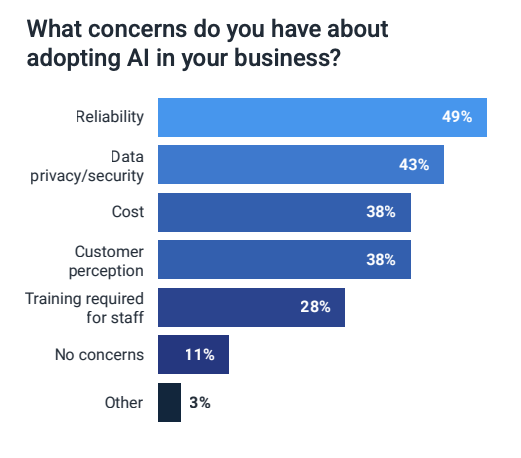
Owners' concerns about AI are also worth looking at directly. The questions are operational: Will it actually work? Will it confuse my customers? Will my team use it? These are the same questions owners ask about any new tool, and they're the right questions to ask.
What pool pros are doing with AI right now
The real-world use cases that have gained the most traction in pool service are writing and communication tasks. Javier Payan, owner of Payan Pool Service in Santee, California, started experimenting with ChatGPT and found immediate value in drafting customer responses, rate increase letters, and company policy updates. Collin Parrish, owner of Blue Desert Pools in Mesa, Arizona, uses it to draft staff policies and social media content. The common thread: these are tasks that already required human review before they went anywhere, which makes them natural candidates for AI assistance. The AI drafts; the owner approves.
Staff onboarding materials, service report writing, and internal documentation have also surfaced as practical starting points. The pattern across all of these is worth naming: the use cases with the most traction are ones where the AI produces a draft of something a human was going to do anyway. Nobody is handing the keys to AI; they're using it to get to a usable first version faster.
AI in marketing: useful, but not without friction
A separate thread worth tracking is AI's role in marketing. Generating social content, drafting email campaigns, and producing website copy are all areas where AI tools can meaningfully reduce time spent. But industry marketing professionals have been consistent in flagging the limitations: generic phrasing, off-brand tone, and the tendency toward overused language are real problems if AI-generated content goes out without careful review.
AQUA Magazine's marketing coverage has pointed out something important about the longer-term picture: as AI infuses digital marketing at every level, the human component becomes more valuable, not less. Personality, local authenticity, and real expertise are what will differentiate pool service businesses in a landscape increasingly full of AI-generated content. The owners who use AI as a drafting tool while keeping their own voice in the final product are positioned well. The ones who hand it over entirely are trading a short-term time saving for a longer-term brand problem.
Where the caution is justified, and where it may be overcorrection
The skepticism in this industry is worth taking seriously. The concerns about AI reliability, data privacy, and cost transparency are legitimate. If an AI-assisted invoicing workflow produces errors in billing, the consequences are real: customer disputes, payment delays, damaged relationships. Owners who are cautious about handing AI control over revenue-critical tasks are making a sound judgment.
There's also a training dimension that doesn't get enough attention. Most AI mistakes in small business settings don't come from the technology failing. They come from unclear instructions or rushed use. An AI tool given a vague prompt produces a vague result. Staff who haven't been shown how to use a tool properly will either misuse it or avoid it. The investment in learning how to work with AI is real, even if it's not large.
That said, some of the caution in the data may reflect a definitional confusion worth unpacking. The 40% of owners who say they'd never trust AI with invoicing and payments may be thinking about AI as a fully autonomous agent making billing decisions without oversight. That's a reasonable thing to reject. But AI as a workflow assistant — flagging overdue invoices, automating reminders, surfacing anomalies for a human to review — is a different proposition. The line worth drawing is between "AI makes the call" and "AI helps me make the call faster."
That said, some of the caution in the data may reflect a definitional confusion worth unpacking. The 40% of owners who say they'd never trust AI with invoicing and payments may be thinking about AI as a fully autonomous agent making billing decisions without oversight. That's a reasonable thing to reject. But AI as a workflow assistant — flagging overdue invoices, automating reminders, surfacing anomalies for a human to review — is a different proposition. The line worth drawing is between "AI makes the call" and "AI helps me make the call faster."
There's also an education gap visible at the smallest end of the market. Research consistently finds that very small businesses are most likely to believe AI simply isn't applicable to their operation, but this belief drops significantly as business size increases. The evidence suggests this is primarily an education problem, not an applicability problem. The use cases exist for solo operators and two-tech shops. The challenge is that owners at this scale often don't have anyone helping them find and evaluate new tools.
How to start using AI in your pool service business
The 2026 State of Pool Service Report offers guidance that lines up well with what small business researchers are also finding: when it comes to AI, start narrow, stay in the loop, and train your team on purpose.
Begin with tasks you'd review anyway. Drafting customer communications, summarizing service notes, generating route suggestions, writing policy updates — these are all areas where AI can speed up the first pass without creating exposure if the output isn't perfect, because a human is checking it before it goes anywhere.
Layer AI into workflows you already have rather than building around it. The framing matters here. AI works best as a complement to your existing systems, not a replacement for the judgment your operation already runs on.
Keep humans in the loop on billing, quoting, and anything customer-facing until you have enough experience with a tool to know how it handles edge cases. This isn't a permanent restriction, it's the sensible starting point.
Set clear parameters early, before you expand use. Defining what AI can and can't do in your operation reduces mistakes and reduces the anxiety your team may have about using new tools. Boundaries are not a sign of distrust in the technology; they're how you use any tool responsibly.
Train your staff with intention. A brief walkthrough of how to write an effective prompt goes a long way. Most errors in AI-assisted workflows trace back to instructions that were too vague or too rushed, not to anything fundamental about the technology.
As AI capabilities become embedded in the software platforms pool pros already use, the assistant model gets easier to adopt. The friction of adding a new tool, learning a new interface, and connecting it to your existing operation decreases when the capability lives inside the system running your routes, billing, and customer communication.
Where things are headed
The 2026 State of Pool Service data describes an industry that is moving from curiosity to utility. Owners aren't chasing AI because it's new. They're evaluating it the way they evaluate every tool: does it actually remove friction, or does it add a different kind? The ones getting the most out of it right now are the ones who started with a narrow use case, reviewed the output before it went out, and built from there.
The market's attitude is, as the report puts it, surprisingly pragmatic. Pool companies aren't chasing hype. They clearly see value where the technology removes repetitive work. And they're holding firm on the boundaries that protect their revenue and their customer relationships. That combination, practical openness paired with clear limits, is exactly the right posture for where AI actually is right now.
The sweet spot in 2026 is using AI as a reliable assistant: let it handle the grunt work while you and your team stay focused on delivering great service and building strong customer relationships. That's not a compromise. It's the point.


