


Frequently Asked Questions
What’s the first step to making a pool business valuable?
Start with owner intent: decide if you want to scale or sell. Growth requires shifting from “doer” to “designer,” letting go of day-to-day control so you can focus on strategy, people, and systems. Casey Graham and Niki Acosta emphasize mindset as the foundation for value.
What are the five buckets that determine a pool business’s value?
Casey Graham outlines: 1) Deal dynamics, 2) Financial profile, 3) Operations, 4) Customers & services, 5) Founder, team & culture. Each bucket affects buyer risk and the business’s day-to-day efficiency.
Which financial metrics buyers care about?
Buyers favor size and stability: annual revenue > $1M, EBITDA > $250K, year-over-year MRR growth, repair margins ~30–50%, comprehensive insurance, and a fully W‑2 employee structure (less 1099). Clean books and tax history matter.
How do operations and software like Skimmer change value?
Operations: 3+ year employee tenure, turnover <20%, formal training, consistent pay, and no legal disputes raise value. Using Skimmer for route density, automated billing/payments, reporting, and customer comms lowers buyer risk and improves valuation.
How can I tell if my business is ready to sell?
Look for clean financials, organized operational data, owner not critical to daily ops, a management layer, balanced revenue (target ~60% service/40% repair), low churn, Google rating 4.5+, and a documented customer acquisition strategy. Use the printable checklist from Skimmer to track gaps.
Key takeaways:
- It starts with the owner’s intent — decide if you want to grow or sell, then move from doer to designer. Your business will only grow as far as you let it; letting go of daily control is part of scaling.
- Value comes from five buckets: deal dynamics, financials, operations, customers & services, and founder/team. Target benchmarks include >$1M revenue, EBITDA >$250K, 60/40 service-to-repair mix, 3+ year employee tenure, low churn, and 4.5+ Google rating.
- Systems win: clean data, documented training, W-2 staffing, automated billing, and route/operations tech (like Skimmer) reduce buyer risk and lift value — buyers pay for predictability, not drama.
- Build for freedom, not just exit value — the same habits that make a business sellable also make it easier and more profitable to run. Use the printable checklist and the podcast/book resources to keep this work practical and organized.
##Key takeaways##
What makes a pool business truly valuable?
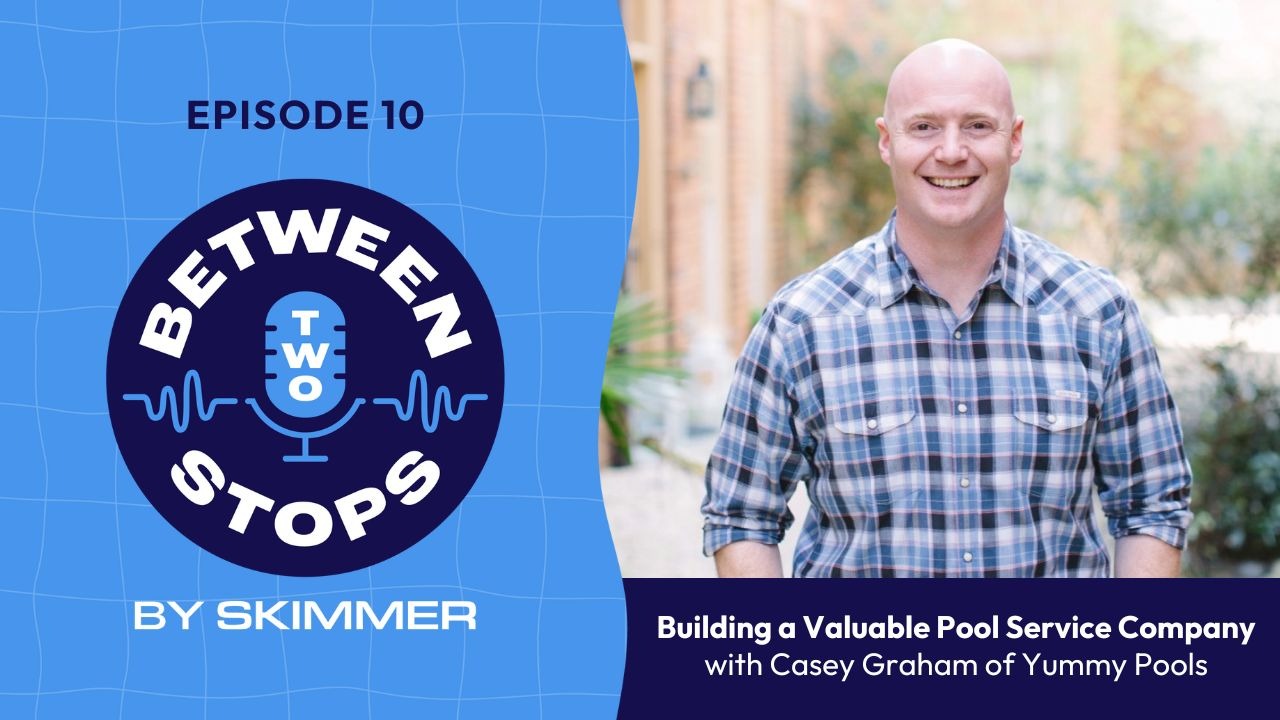
In this episode of Between Two Stops, host Niki Acosta sits down with Casey Graham, co-founder of Yummy Pools and author of From Skimming to Scaling. Casey shares a framework for building a pool company that thrives — and that’s worth more, whether or not you ever sell it.
The conversation dives into mindset, structure, and the five “buckets” that define a truly valuable business.
It starts with the owner’s intent
Not every pool pro wants to scale, and that’s okay. But if your goal is to grow or one day sell, the first step is mindset. Growth requires change — especially learning to let go of control.
“Your business will only grow at the level that you grow,” says Casey. “The larger your business, the less control you’ll have personally.”
When you shift from doer to designer, you move from working in the business to working on it — freeing yourself to focus on strategy, people, and systems.
Understand what drives business value (plus a checklist for your business)
Revenue and pool count don’t tell the full story. Casey outlines the factors that influence how a business is valued, grouped into five key buckets.
Each one affects how attractive your business looks to potential buyers — and how efficiently it runs for you today.
Bucket 1: Deal dynamics
Why you’re selling, the quality of your data, and how realistic your valuation expectations are. Burnout lowers value. Clean data, clear records, and realistic expectations raise it.
- Clear reason for sale (not burnout)
- Organized financial and operational data
- Clean tax history
- Realistic expectations about valuation
Bucket 2: Financial profile
Size and structure matter. Cleaning and repair revenue over $1 million, growing MRR, solid margins, and proper insurance coverage increase buyer confidence. “Private equity groups love bigger, healthier businesses — not because of the money, but because of lower risk.”
- Annual revenue over $1M
- EBITDA over $250K
- MRR growth year-over-year
- Repair margins at 30–50%
- Comprehensive insurance coverage
- Fully W-2 employee structure
Bucket 3: operations
Employee tenure, training systems, compensation structure, and use of technology all impact value. High turnover or 1099-heavy workforces reduce it. Using a platform like Skimmer for route density, billing automation, and reporting increases it.
- Employee tenure 3+ years
- Low turnover (<20%)
- Formal training program and documentation
- Consistent pay structure
- Tech platform (e.g. Skimmer) managing routes, billing, and comms
- Automated billing and payments
- No legal disputes
“Taking time to get all your data into Skimmer can increase the value of your business significantly,” Casey notes. “When buyers see clean systems, they see lower risk.”
Bucket 4: Customers & services
Balanced revenue (ideally 60% service / 40% repair), strong pricing, low churn, and consistent growth build a healthy customer base. A strong digital presence — reviews, SEO, and clear acquisition channels — adds even more value.
- 60% service / 40% repair mix
- Above-market pricing strategy
- Year-round weekly service (not seasonal)
- Low churn, strong retention
- Google rating 4.5+ stars
- Clear customer acquisition strategy
- 3+ year customer average tenure
“Buyers pay for reputation they can’t buy anywhere else — organic growth is gold.”
Bucket 5: Founder, team & culture
Buyers value leadership that isn’t essential to daily operations. A clean brand, consistent culture, and professional structure matter. The less “key man risk” your business carries, the more valuable it becomes.
- Owner not critical to daily operations
- Management or leadership layer in place
- Consistent branding (uniforms, trucks, signage)
- Positive team culture with growth paths
- Owner willing to stay on post-sale (if selling)
📄 Get a printable checklist to keep track of all these growth factors.
Build systems, not stress
Every habit that makes your business attractive to a buyer — clean books, solid training, recurring revenue — also makes it easier to run.
“Even if you never sell, you’ll be the beneficiary of a valuable business,” Casey says. “You’ll build a machine that operates without you.”
Final word: The chemistry of value
This isn’t about pool chemistry or equipment — it’s about the chemistry of value creation. Build your business with structure, clarity, and intent. The result is freedom, confidence, and long-term success.
“When we all build better, more professional businesses, everyone wins,” Niki says. “The pros, the employees, and the entire industry.”
🎧 Listen to the full episode of Between Two Stops featuring Casey Graham of Yummy Pools.
📘 Download the free book From Skimming to Scaling from Skimmer.


