


Frequently asked questions
What is the quote-to-cash workflow in pool service?
It's the end-to-end process that starts when a customer agrees to a job and ends when payment is collected. It includes quoting, job scheduling, field documentation, invoicing, and payment collection. When any step in that chain is disconnected or manual, money gets lost.
Why do pool service businesses lose money on completed jobs?
The most common causes are undocumented add-ons, invoicing delays, and jobs that were sold with one scope but completed with another. None of these are customer problems — they're workflow problems. If the field data doesn't flow automatically into the invoice, someone has to reconstruct what happened, and reconstruction is where details fall through.
How does a deposit protect my business?
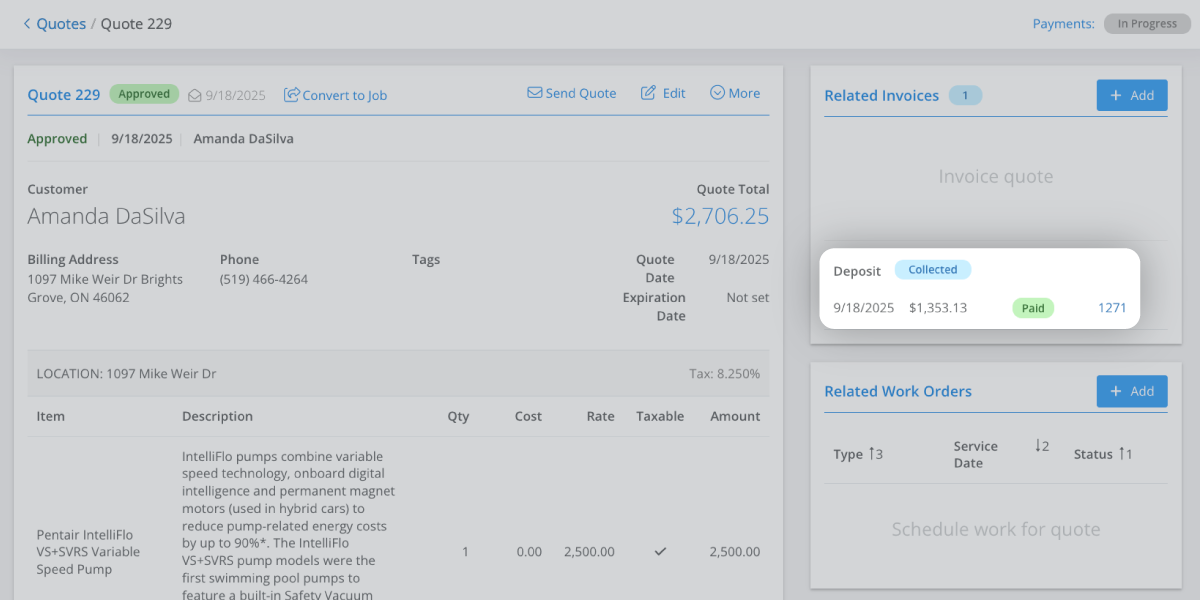
A deposit collected at the time of quote approval creates financial commitment before any labor or materials are invested. It reduces the likelihood of a customer walking away after saying yes and provides partial coverage if a job is cancelled after materials have been ordered.
What causes invoice delays, and why do they matter?
Delays usually happen when invoicing is done in batches, separately from field operations. The longer the gap between completed work and invoice delivery, the slower the customer pays — and the more likely the invoice is to omit add-ons or extras that weren't properly documented. Same-day invoicing, built from job line items, eliminates both problems.
What's the difference between autopay and a card on file?
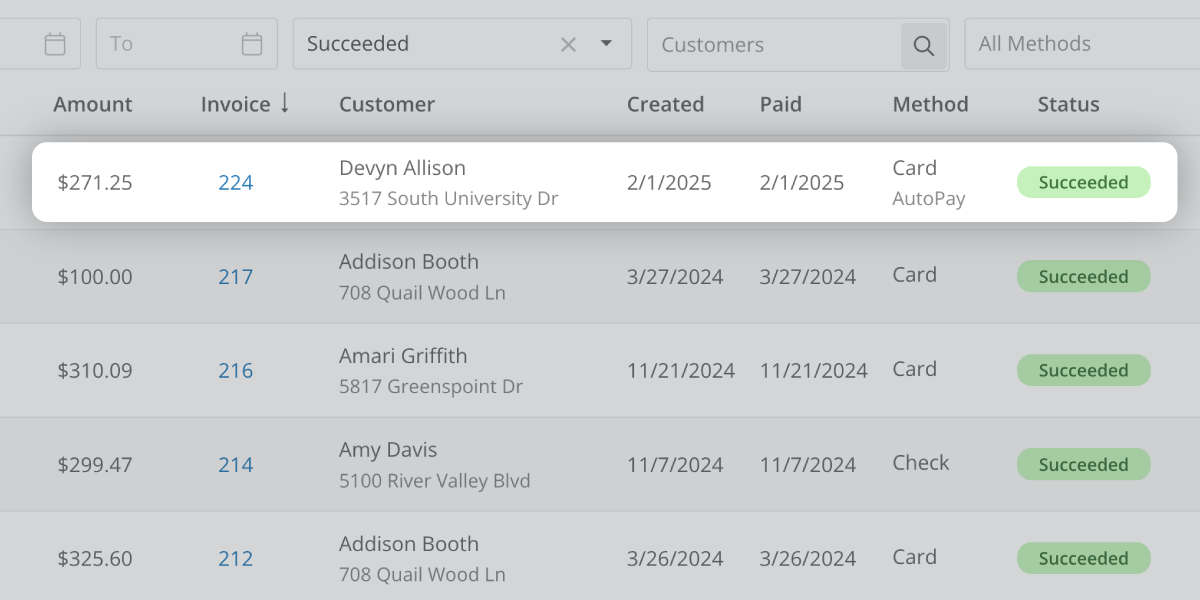
Autopay is typically used for recurring service customers: a payment method is stored and charges run automatically on a defined schedule, requiring no action from either party. A card on file is used for one-time or repair jobs: the payment method is stored and charged at job completion, rather than waiting for the customer to respond to an invoice.
How should I handle customers with overdue balances?
Automated overdue reminders handle the routine touchpoints without requiring staff to make individual collection calls. Aged receivables reports surface which accounts have gone past 30, 60, or 90 days so problems are caught early. For persistent non-payers, auto-suspend policies remove the uncomfortable judgment call by applying a consistent, pre-set rule across all accounts.
Does surcharging make sense for pool service businesses?
It depends on your market and applicable state law. Where permitted, surcharging passes credit card processing fees to the customer, which can meaningfully reduce overhead on high-volume card transactions. Whether customers accept it depends on how it's communicated and what competitors in your area are doing.
What's the most common sign that a quote-to-cash workflow is broken?
Cash flow shortfalls that don't match your job volume. If the business is busy but money is tight, it usually means revenue is being earned but not fully collected — either through underbilling, delayed invoicing, or accounts that have slipped past due without being followed up on.
Key takeaways
The quote-to-cash workflow is a system, and most revenue leakage in pool service businesses comes from gaps in that system, not from bad customers or bad work. Six problems show up consistently:
Written quotes and formal approvals prevent disputes before they start. Deposits collected at sign-off reduce job abandonment and protect cash flow before any work is scheduled. Real-time field documentation ensures that everything done gets billed, with a record to back it up. A clean handoff from approved quote to scheduled job means the work that was sold is the work that gets done. Same-day invoicing, generated directly from job line items, closes the gap between completed work and payment. And systematic payment collection, through autopay, cards on file, and automated reminders, removes the friction that lets accounts go overdue.
Every one of these problems is a process failure. Fix the process, and the revenue follows.
##TOC##
##Key takeaways##
The gap between a customer saying "yes" and payment landing in your account is where pool service businesses quietly hemorrhage revenue. Most operators focus on doing the work. Few build a tight system around getting paid for it.
This isn't a criticism — it reflects where most operators spend their training, their attention, and their energy. Cleaning pools and keeping customers happy are the visible parts of the business. The quote-to-cash workflow is invisible until something breaks. And when it breaks, it rarely shows up as a single dramatic loss. It shows up as money that was earned but never collected, disputes that could have been prevented, and jobs that were finished weeks before the invoice went out.
This post walks through the most common breakdowns in the quote-to-cash workflow and what a properly connected process actually looks like.
Issue #1: The quote never becomes a document
Many pool service jobs start with a conversation. A tech walks the property, talks through what needs to happen, gets a verbal nod, and schedules the work. No written scope. No line items. No approval on record.
This works until it doesn't. When a customer sees the invoice and questions the price, the scope, or the parts involved, there's no document to point to. The dispute becomes a memory contest, and those are difficult to win.
Verbal quotes also make it hard to build any kind of pricing consistency. Without a written record, it's difficult to know whether similar jobs are being quoted similarly, or whether margin is getting quietly compressed job by job.
The fix
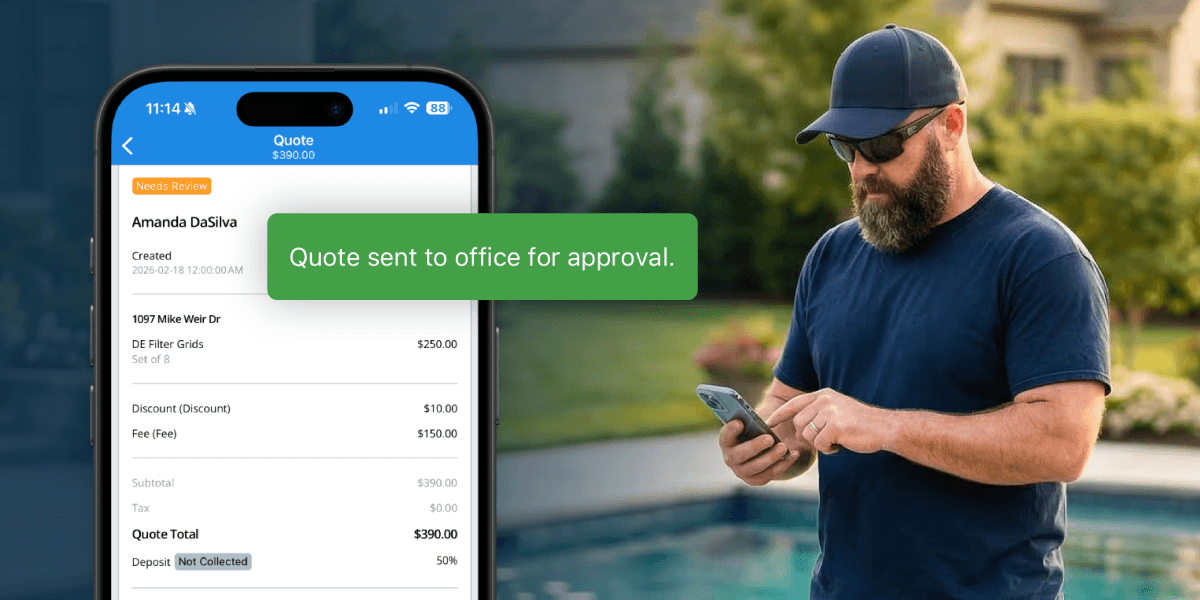
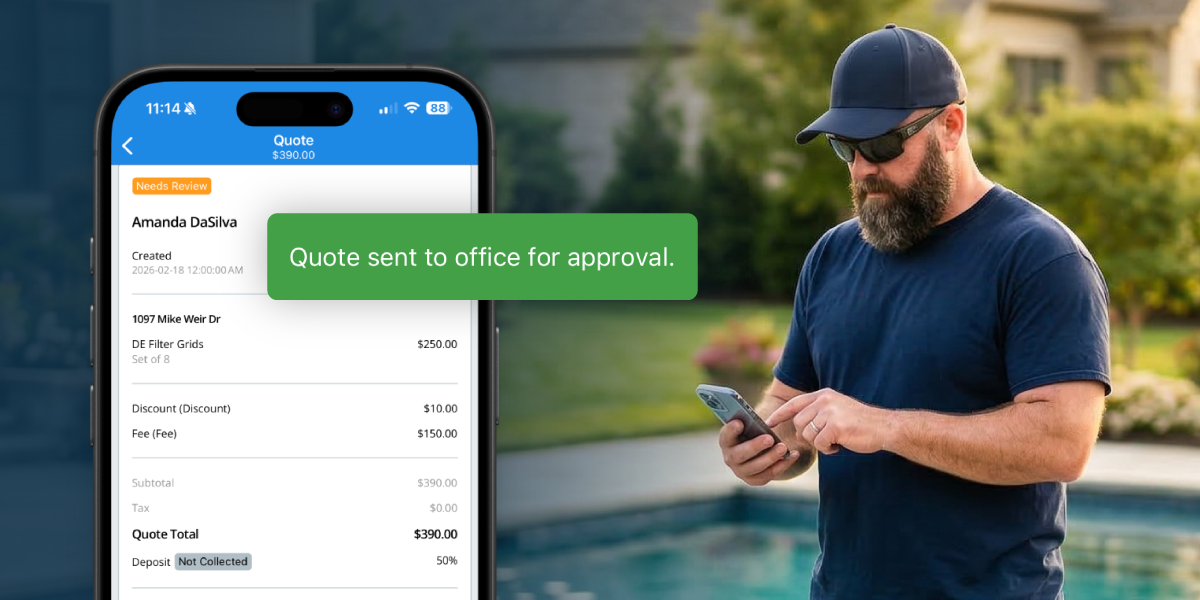
A written quote, formatted as a branded proposal with line items and photos where relevant, solves this problem at the source. The proposal should include a formal approval step before any work begins — not a text message confirmation, but a documented sign-off that creates a shared record of what was agreed. That record then feeds directly into the job and the invoice, with no re-entry required. The customer knows what they approved. The business has proof.
Issue #2: Scope creep goes untracked
The "while I'm here" problem is pervasive in pool service. A tech shows up for a scheduled repair and notices the filter needs cleaning. The customer asks about a leak at the equipment pad. There's an opportunity to swap out an aging valve. These additions are often handled on the spot, which is good for the customer relationship and genuinely bad for the business if none of it gets documented.
Unbilled add-ons and undocumented extras erode margin slowly and invisibly. Individually, each one may seem small. Across hundreds of stops over a season, the accumulated losses are significant. The chemicals that got used but never tracked. The part that got swapped without a line item. The extra hour that didn't make it onto the invoice.
There's also a downstream risk: undocumented work creates liability. If a customer later disputes whether a repair was made or a chemical was applied, there's no record to reference.
The fix
The foundation is a change work order habit, supported by chemical and item tracking built directly into the field workflow. When techs log what they've used and done at each stop in real time, from a mobile device, that information flows forward into the invoice automatically. Nothing needs to be reconstructed later from memory or a paper slip. What got used is what gets billed, and the record exists if a customer ever questions it.
Issue #3: The quote-to-job handoff breaks down
An approved quote is not a scheduled job. That transition, from signed proposal to work on the calendar with a tech assigned, materials identified, and scope understood, is where a surprising amount of information gets lost.
In businesses that run quote and job management in separate systems, this handoff requires manual re-entry. Someone types the scope into a new work order. Details get abbreviated. Line items get dropped. Parts that were specified in the quote don't make it onto the job, so the tech arrives without what they need or orders the wrong thing.
When the office and field aren't working from the same information, the job that was sold isn't always the job that gets done. Plumbing fixtures, specific equipment models, promised timelines: these are the kinds of details that fall out during re-keying and cost the business credibility and margin.
The fix
When quoting and job management live in the same system, the handoff becomes a single action rather than a translation exercise. The scope, line items, photos, and customer notes from the approved quote carry forward directly into the work order. The tech in the field sees exactly what was sold. The office sees exactly what's scheduled. Nothing gets abbreviated, dropped, or misremembered between systems.
Repair and renovation jobs add another layer: multiple phases, partial completions, and deposits that need to carry through to the final invoice. See how to build that system for larger repair jobs.
Issue #4: Invoicing lags behind completed work
Finishing the job and sending the invoice are two different actions, and for many pool service businesses, there's a significant gap between them. Invoicing gets batched. It happens at the end of the week, or when the office has a slow afternoon, or after the owner gets around to it on Sunday evening.
That delay is not a minor inconvenience. Invoice timing directly correlates with payment speed. The longer the gap between completed work and invoice delivery, the longer it takes for the customer to pay and the more likely the job is to fade from memory, reducing the psychological urgency to settle the balance.
There's also a secondary problem: the longer an invoice sits as a draft, the higher the risk that it no longer accurately reflects what was done. Notes get incomplete. Add-ons get forgotten. The final invoice becomes an approximation of the job rather than a record of it.
The fix
Invoices built directly from job line items solve both problems at once. Because the invoice reflects exactly what was logged during the job, there's no reconstruction required and no risk of underbilling. Bulk invoice generation makes it possible to process a full day's worth of completed work in a single action, and automated delivery gets the invoice to the customer the same day the work is done. Any deposit collected at quote approval applies automatically to the final balance, so the customer receives an accurate, ready-to-pay invoice without any additional back-and-forth.
Issue #5: Payment terms and collection are an afterthought
Many pool service businesses still operate with payment terms that are more convenient for the customer than for the business: vague due dates, no stored payment method, no autopay option, a default assumption that customers will mail a check.
These frictions are not neutral. Every step between a customer receiving an invoice and completing payment is an opportunity for the payment to be delayed or missed. A customer who would otherwise pay immediately may set the invoice aside when their preferred method isn't available. A check that hasn't arrived by day 30 may require a phone call. A missed autopay may go undetected until it appears on an aged receivables report weeks later.
Pool service businesses also have options that many operators underuse: surcharging, which allows credit card processing fees to be passed to the customer where permitted by law; and financing, which makes larger repair and equipment jobs accessible to customers who might otherwise delay or decline.
The fix
Autopay for recurring service customers removes collection from the equation entirely. When a payment method is stored and a charge runs automatically on schedule, the business gets paid without any action required on either side. Card on file for repair and one-time work extends the same logic: payment happens at completion, not whenever the customer gets around to it. Online payment options through a customer portal reduce friction further by letting customers pay from their phone on their own timeline. Setting clear due dates on every invoice and enforcing them consistently signals that the business runs professionally and expects to be paid accordingly.
Issue #6: There's no visibility until it's a crisis
Overdue accounts don't always announce themselves. In businesses without systematic receivables tracking, unpaid invoices accumulate quietly until a cash flow shortfall forces the issue. By that point, some accounts are 60 or 90 days out, and collection becomes significantly harder.
The same dynamic plays out with failed autopay transactions. A payment method expires, a card gets replaced, a bank account changes, and the failed charge sits unaddressed until either the customer notices or the business does a manual audit.
Without automated alerts and escalation processes, this monitoring falls to whoever has time to do it, which often means it doesn't happen consistently.
The fix
Automated overdue reminders create a systematic, professional touchpoint with customers who owe a balance, without requiring a staff member to make individual collection calls. Failed payment alerts notify both the customer and the business immediately so the issue can be resolved before it compounds. Aged receivables reporting gives owners and office managers a clear view of outstanding balances by age, so problems surface before they become cash flow emergencies. Auto-suspend for non-paying accounts removes the human discomfort from enforcement — the policy is set once and applied consistently across every account.
Conclusion
Each of these breakdowns is a process problem, not a customer problem. Customers don't pay late because they're difficult — they pay late because the system made it easy to delay. Jobs get underbilled because the workflow didn't capture what was done. Disputes arise because no one wrote anything down.
A connected quote-to-cash workflow, where quotes convert cleanly to jobs, completed work flows automatically into invoices, and payment is collected without manual follow-up, removes the points of failure that drain revenue quietly over time. That's what separates businesses that grow predictably from ones that are always chasing money.


