


FAQs
Does getting more efficient mean I have to add more pools?
No — and that's the point most owners miss. Adding pools isn't the easiest or most reliable way to grow profit, because new customers are the hardest ones to keep and the most expensive to win. The bigger lever is making small changes to how you already service the houses on your routes today. Tighten the day-to-day and you make more money on the work you're already doing, without the chaos that comes with chasing volume.
What's the single highest-impact change I can make in the backyard?
Get the equipment running the way it should. The pump is the driver of everything — if it isn't running, the filter isn't filtering and the cleaning system isn't cleaning. Setting pumps to run on a 24-hour schedule, keeping filters on a routine cleaning cadence, and making sure cleaning and chlorination systems actually work turns the equipment into a 7-day-a-week employee. Do that and a stop that used to take two hours can take ten to fifteen minutes.
How do I cut down on go-backs?
Prevent the problem before it starts. Most go-backs trace back to algae, and proper, frequent brushing is the cheapest way to prevent algae — your tech is already at the house doing it. Pair that with standardized truck inventory (so techs aren't driving back to the shop for an O-ring) and better issue identification (spotting which houses and which techs keep creating repeat visits). Getting it right the first time saves time, the chemicals, and the trust.
My techs all write notes differently and it's costing me time. What do I do?
Standardize the format so anyone can read a note at a glance and know what happened. One operator on the webinar uses a simple fixed set of questions on every stop: Is the job finished — yes or no? Did you speak to the customer — yes or no? Was it standard time, and if not, why? Is a quote needed for anything you noticed? When the answers are consistent (“yes, yes, no, yes”), scheduling and billing both get faster, and you stop sending invoices for jobs that aren't actually done.
How is AI Phone different from a normal answering service?
AI Phone answers inbound calls when you can't — on a route, after hours, or just slammed. It's trained on pool industry knowledge, handles realistic service scenarios, and you keep your existing number by forwarding it to the Skimmer-provided number. You can add custom knowledge and set transfer rules so the right call types reach the right person, and everything is logged inside Skimmer with a transcript. It sets up in about ten minutes, and one customer generated over $30k in quotes after turning it on.
Key takeaways
- Efficiency, not headcount, drives profitability — micro-changes in your day-to-day create major long-term impact, and they pay off on the houses you already service.
- 90% of what a homeowner cares about is a clean pool; 90% of what a pool company should care about is whether the equipment is working. Turn the equipment into your hardest-working employee and a clean pool becomes the byproduct.
- Go-backs are one of the clearest signs that systems haven't kept up with volume. Prevent algae proactively, standardize truck inventory, and learn to spot patterns to get it right the first time.
- Consistent service days, tight routes, and smart expansion matter more than raw pool count — more pools does not always mean more profit.
- Cross-training, standardized notes, and using senior techs to train employees protect you when something breaks, because panic is not a backup plan.
- Clear, realistic expectations with both customers and employees prevent the trickle-down of negativity — retire use of the word, “ASAP,” give real timeframes, and never over-promise.
- Burnout builds quietly when stress outweighs recovery for too long; better systems and sustainable teams are the real prevention. Prepare in the off months, not in July.
- AI Phone is available now and sets up in 10 minutes; Office Alerts and Issues are coming in June to make Skimmer more proactive.
##TOC##
##Key takeaways##
Busy season is the moment every pool company's systems get stress-tested. Volume peaks, the schedule fills, the phone won't stop, and the gap between the businesses that thrive and the ones that just survive gets wide fast. Here's the thing worth holding onto before we get into tactics: the companies that come out ahead usually aren't the biggest ones. They're the most operationally efficient.
That was the throughline of our recent webinar, Built for Busy Season: Creating Efficiency at Full Capacity, featuring Sarah Hoopes, Director of Operations at AE Pool Services. Sarah has spent ten years in the industry — as a receptionist, office manager, director of operations, general manager, and owner — and helped grow an operation to roughly 725 pools and 23 employees before moving to Washington State to run operations for AE Pool Services. Her approach is relentlessly practical, and the recurring message was simple: small operational changes, repeated consistently, are what keep your team moving and your margins intact when the pressure is on.
This recap pulls Sarah’s most useful pieces of advice together so you can put them to work this week. You can also watch the full session on demand here.
Why efficiency matters more than another pool
Sarah opened with a line that sounds like a contradiction but really isn't: repetition may be boring, but ultimately it's efficient. Netting and brushing a pool aren't efficient the first time a tech does them. But you get efficient through reps. Office work and business management are no different. You sit down and run the same process over and over until you can practically do it in your sleep, and that's the point where it stops costing you time.
The reason this matters is that efficiency, not growth, is what actually drives profitability. Adding pools is not always the easiest way to make money — existing customers are more likely to stay than new ones, and the constant hunt for new accounts is rarely the most profitable use of your time. The micro-changes in your day-to-day are what compound: less time per stop, fewer interruptions pulling you away, fewer mistakes to clean up. As Sarah put it, the processes you put in place at the beginning are what drive profitability in the long run.
Efficiency also pays off in places that don't show up on an invoice. It improves team performance, because your employees are the ones implementing these plans in the field, and a job that's more efficient is one that respects their time. It improves customer satisfaction, because a smoother day-to-day builds the kind of trust that makes long-term, good-paying customers more forgiving when you do make a mistake — and everyone makes mistakes. And it lets you reach capacity without adding chaos.
There's a catch worth naming: efficiency is never “done.” The moment you've nailed it at your current size and you're ready to grow, you start the process over, because what works at 300 pools isn't what works at 1,000. The fix is to build for the next stage now. If you don't have employees yet, set your business up as if you already do: write the plans, document the routes, get it out of your head. The moment your answer to a question is “I don't know, it's just in my head,” you've found an inefficiency.
The key takeaway here: Micro-changes in your day-to-day create major long-term impact.
Backyard efficiency: turn your equipment into an employee
Here's a reframe that changes how you think about every stop: the equipment in the backyard is the hardest-working employee you have. About 90% of what a homeowner cares about is whether the pool is clean. About 90% of what a pool company should care about is whether the equipment is functioning. Homeowners mostly don't care whether the pump runs or the filter works — they care that the water's clear and the kids can get in. A clean pool is just the bonus you get when the equipment is doing its job.
Since you're not there to clean the pool every day, the equipment has to be. Small adjustments save enormous time across a route:
- Pumps. Run variable-speed pumps on a 24-hour schedule. The pump is the driver of everything else — your filter only filters while water moves through it, so a homeowner with a $2,000 filter and a pump running four hours a day owns a $2,000 piece of equipment that's mostly doing nothing. (The shift from single-speed to variable-speed pumps makes the homeowner conversation harder, especially where electricity is expensive, but breaking down the kilowatt-hour math is usually enough to win it.)
- Filtration. Put customers on routine filter cleans. Beyond keeping water moving — which means the pump doesn't have to work as hard or ramp RPMs — it's a significant revenue generator. One operator changed his filter-clean plan in 2025 and added roughly $80,000 a year in revenue from filter cleans alone.
- Cleaning systems. Where they're common, a functioning cleaning system is your 24/7 employee. When it's doing its job, a tech spends ten to fifteen minutes at a stop instead of two hours, because the pool has effectively cleaned itself.
- Chlorination systems. Think of chlorination as the backup dancer — it supports everything else and keeps the water sanitized, which is what actually prevents the go-backs in the next section.
The key takeaway here: Small adjustments save significant time across every route.
Preventing go-backs
Nothing throws a wrench into your day like having to drive to a house you didn't plan on visiting — and about 90% of the time, that house turns out to be all the way across town. Every go-back adds time and money you didn't budget for. The goal is to stop them at the source.
Prevent algae proactively: Proper, frequent brushing is the easiest and cheapest way to prevent algae — and your tech is already at the house every week to do it. The only real cost is the net and the brush, which pay for themselves the first time you avoid going back three days in a row to fight a bloom.
Equip your techs properly: Standardize what's on every truck and apply the rule across the board. A tech who's missing a screwdriver or an O-ring is a tech driving back to a shop that, in some regions, is three hours away one way. Standardized trucks also mean you can plug and play — a truck breaks down, and you just put that tech in the blue truck and call it a day. The trap here is exceptions: every exception to the rule is something you now have to remember and re-apply, and there's only one of you and a whole crew of them. Exceptions cause chaos.
Improve issue identification: Once equipment is dialed in and techs are equipped, the struggles that remain become legible. If a tech is taking too long on a route where everything is set up correctly, that's worth a closer look. If Jennifer's house grows algae every three weeks like clockwork, that's worth an investigation — which might reveal that the landscapers come that morning, which leads to a basket-check add-on the customer pays for. Patterns tell you what to cut, what to fix, and where you're undercharging for a pool that quietly eats three hours.
The key takeaway here: Getting it right the first time saves time and money.
Route optimization and localization
Whether you service 10 square miles or 100, the same principles apply — and the headline one is that more pools does not always equal more profit.
Start with consistent service days. AE Pool Services tells customers up front: we're in this town on Mondays, full stop. That single rule does triple duty. It helps customers plan their own pool time (a parent who knows you're coming Monday can get the kids out of the house), it cuts down the “when will you be here?” phone calls, and it gives you a cheat sheet for adding new accounts — a new house in that town simply goes on the Monday route.
Consistent days also reduce unnecessary drive time, which is pure cost: gas, tires, truck maintenance, and the hours a tech spends behind a windshield instead of at a pool. Driving three hours around town to hit four jobs is the definition of inefficient; doing it one area at a time is the fix.
When you plan expansion, grow into the space between areas you already serve rather than in two opposite directions. If Monday is area A and you grow into area B, the gap in the middle (area C) becomes your next move — so when you do have to do a go-back in A, you're already nearby in B. And prioritize profitable routes: if one pool sits far from everyone else, ask whether it's worth it, or charge appropriately for the distance.
The key takeaway here: More pools does not always equal more profit.
Cross-training and team development
Cross-training matters for one blunt reason: panic is not an effective backup plan. We've all pulled up to a house, had no idea what we were looking at, started calling people who were across town, and walked away — only to drive back later to figure it out. A cross-trained tech who can handle a pump swap or a filter issue on the spot, three hours from the shop, eliminates that second trip entirely. Over time the cross-training also creates your next trainer: the tech you invested in becomes the person who onboards the next hire.
Standardize notes and communication so anyone can glance at a stop and know exactly what happened. When techs each wrote notes their own way, AE couldn't always tell whether a job was finished, which meant calling the tech, who then had to remember the house. So they taped a standard format to the wall: Is it finished — yes or no? Did you speak to the customer — yes or no? Was it standard time, and if not, why? Is a quote needed for anything you noticed? Standardized answers made scheduling faster and billing cleaner — because the fastest way to anger a homeowner is to bill for a job that isn't actually done.
Use senior techs for training. They have a buy-in to the company and a personal interest in training someone well, since they're often the one going back to fix what a new tech couldn't. It strengthens onboarding by giving the new hire a peer to ask, and it creates accountability — a new tech can't quietly cut corners the way a veteran can, and if they were taught a certain way, you know exactly who to check with.
The key takeaway here: Better-trained teams reduce interruptions and improve consistency.
Time management and effective communication
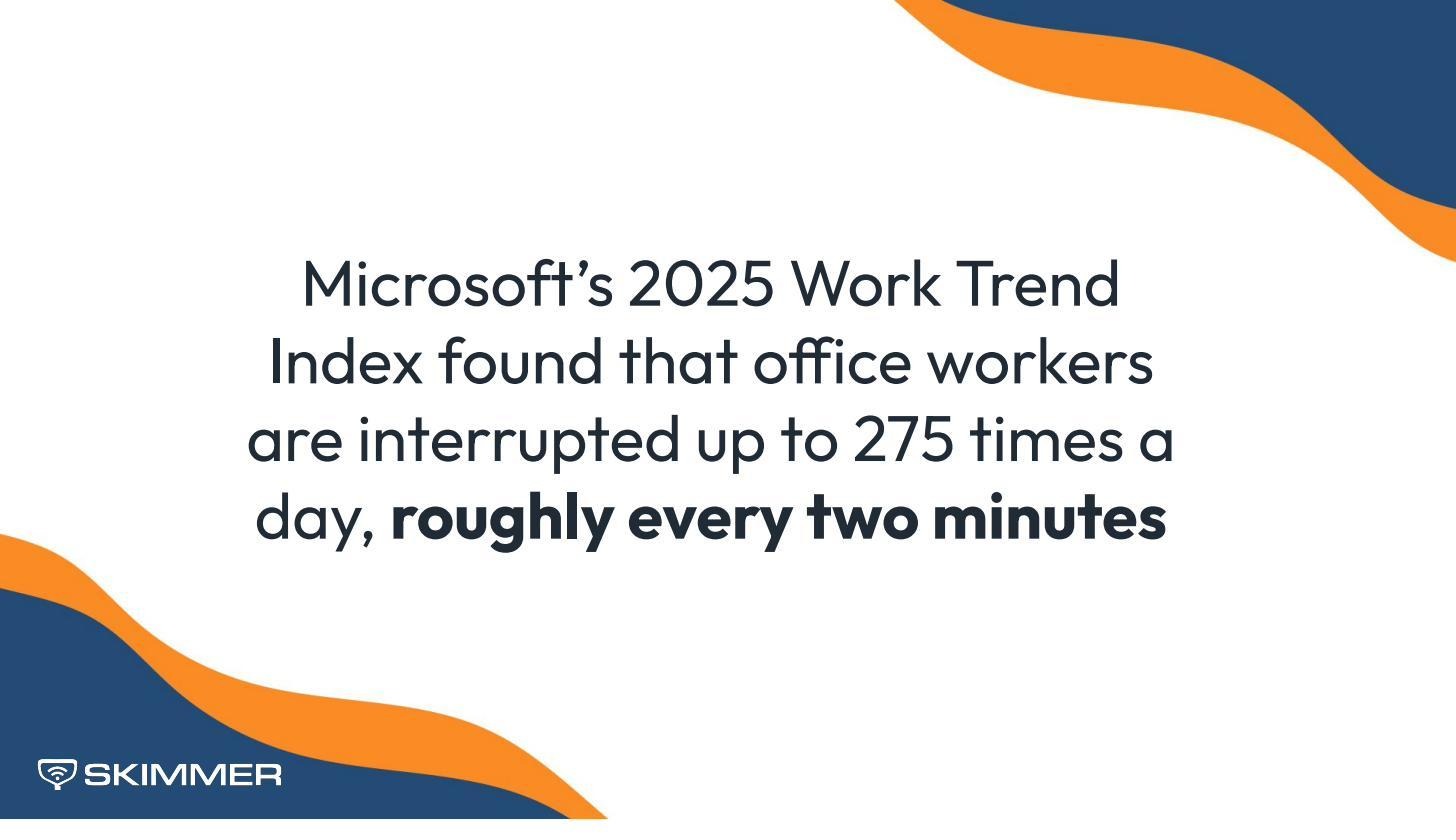
If you've ever gone home feeling like you accomplished nothing, there may be a reason: Microsoft's 2025 Work Trend Index found that office workers are interrupted up to 275 times a day — roughly every two minutes. You can't run a tight operation inside that.
Reduce interruptions. Sarah uses her iPhone's focus settings on an automatic work schedule so the social and marketing notifications don't pull her attention all day. Set parameters with employees, too. Pool techs spend most of the day alone and want to debrief the moment they're back, so she asks one question: is this a business conversation or a fun conversation? A fun conversation gets five real minutes; a business conversation gets her undivided attention until it's solved. People still feel heard — and they learn to respect the time.
Pick a time-management strategy and actually use one. There are dozens worth Googling. Sarah uses the Pomodoro technique (work, short break, repeat, then a longer break) and the 2-minute rule (if something takes under two minutes, do it now; if not, set it aside for your next break). Getting yanked off a project mid-stream is costly — you rarely get right back in, and suddenly you're five problems down the road with one slide finished.
Delegate effectively — which is not the same as delegating. Delegation is just getting work off your plate (“here's the project, here's how I want it done, go”). The first time it's not done exactly your way, you re-show them; a couple rounds later you've decided it's “easier if I just do it myself,” and now you're doing 45 jobs in an 8-hour day while getting interrupted every two minutes. Effective delegation means assigning ownership with clarity and support: set a clear goal (track the filter-clean revenue for the year, here's the rate and the cadence, tell me the total at twelve months), explain what you're trying to achieve, and then let them own it. People take pride in a project that's genuinely theirs.
Use canned emails and templates. It's far easier to change a date or a price on an existing email than to rewrite it. A saved “welcome to service” email that spells out what's included, the cost, and the plan protects you when a customer later says “no one ever told me” — because the email did. Create them once, send them forever.
The key takeaway here: Consistency improves both efficiency and customer experience.
Setting realistic expectations
The fastest way to disappoint a customer is to create an expectation you can't meet — so the whole game is making promises you can actually keep.
Retire “ASAP.” To a homeowner with five kids screaming to swim, ASAP means now. To a slammed office, it means after lunch, if no new fires start — and then it's the next day and they're calling back, grouchy, doubting you'd ever follow up. Give a real timeframe instead. AE's voicemail says they'll call back within 24 business hours — not “soon,” not “right back.” When you tell someone you'll call “right back,” what does “right” mean? “I'll talk to John and call you by the end of day” lets you solve it on your own timeline and takes the “this is a fire” energy out of the situation. Save the fire response for the actual fire — a tech with a flat tire, not a misplaced vacuum.
Communicate proactively, especially about money. AE uses Skimmer reports so homeowners can see exactly what was added to the pool, how many chemicals were used, and any parts installed. That removes the “I didn't know” call before it happens. Newsletters and monthly emails do the same job at scale — “it's pool-closing time,” “here's what to do in a storm” — and they double as a soft sell: tell people to put a cover on, and someone without one will call to buy one.
Don't over-promise. It's the quickest way to lose trust and the surest way to send a homeowner down a rabbit hole. Promise your tech will empty every basket every time and never miss, and the first missed leaf becomes evidence you can't be trusted with anything. The culprit is usually the words never and always. Describe what you provide and how you do it — and take every complaint seriously, because as silly as a single rock on the pool floor may seem, that homeowner is paying you to get it out.
The key takeaway here: Clear expectations reduce frustration and increase trust.
Preventing burnout
Burnout doesn't happen overnight. It happens when stress outweighs recovery for far too long. There's no magic solution for this but there are habits that help.
Prepare in the off months. July is not the time to switch software, change a service plan, or roll out a new policy — outside of a genuine emergency. Build and change in the slower season, then let the busy season run on systems you already trust.
Recognize the symptoms — in yourself and your team. The list is long (irritability, poor sleep, not eating right, constant stress), and the skill is catching it early enough to step back. Sometimes that's a five-minute walk where you leave your phone on the desk — if you bring the problem with you, you haven't taken a break, you've just moved your bad phone call outside. Sometimes it's phoning a friend in the industry; Sarah called a peer for a quick chat about burnout that turned into a 77-minute conversation that helped them both. Feeding back into yourself during the busy stretch isn't indulgent — if you're burnt out, your stress flows downhill to your whole team.
Build sustainable teams. Better systems reduce stress because you're not reinventing the wheel every time — you build a process once and repeat it. And sustainable growth requires sustainable people: an employee whose tank is empty after twelve-hour days isn't going to want more responsibility, no matter how much you want to grow them. Celebrate the techs who are happy where they are, and give the ones who want to grow more responsibility without piling on more burnout. If you're a single-truck operation, joining a network or peer group is one of the better ways to keep your own tank full.
The key takeaway here: Efficiency protects both your people and your business.
Make your software work for you
Sarah's systems all share one assumption: the information lives somewhere reliable, not in your head or on a sticky note. Sticky notes and memory are not scalable systems. Good software should simplify operations, not complicate them, and it earns its keep in a few specific ways:
- Automate repetitive tasks. Recurring checklist items and recurring work orders make sure things like filter cleans actually happen on schedule — set it once and stop tracking it manually.
- Improve communication. Treat your CRM as protection for the business: techs pushing information to the customer from the field, and a record that backs you up when a question comes later.
- Track operational trends. Spot which routes and services are profitable, plan ahead so you're not scrambling for product, and see how long techs spend at each house — which tells you where you might be undercharging.
- Increase visibility across teams. When every supervisor sees the same information, the system creates its own checks and balances.
What Skimmer is building
AI Phone is available now, and it sets up in about ten minutes. It answers inbound calls when you're unavailable — on a route, after hours, or just heads-down — and it's trained on real pool industry knowledge to handle customer questions intelligently. You keep your own number by forwarding it to the Skimmer-provided number (your carrier handles the forwarding rule, and you can forward always or only during certain hours). Add custom knowledge and transfer rules so the right calls reach the right person, and everything is logged in Skimmer with a full transcript. One customer has generated over $30k in quotes after enabling it; another, an Arizona pro, landed two new customers within ten minutes of turning it on — an acid wash and a service account he'd otherwise have missed. It puts an enterprise-grade answering service in reach of a small business, and it works alongside VoIP services like Google Voice and Grasshopper.
Office Alerts and Issues are coming soon! Office Alerts are automated notifications that fire the moment an operational exception happens — chemistry or dosage readings out of range, late starts, skipped stops, missed routes, failed or overdue payments, payment-method changes, and more — so you know there's a problem with a pool or a tech before your customer does. Issues give field techs a structured, mobile-native way to flag a problem at a property: the tech picks an issue type, adds a description and optional required photos, and submits from their phone; the issue lands in a filterable, sortable list on the web app with a status and the right people looped in, plus an optional customer email separate from the service email. Both were in beta at the time of the webinar.
Prioritize and pick a struggle
If there's one note to end on, it's this: you will never be perfect, but you can be better. Sarah covered a lot, and trying to fix all of it at once is its own kind of inefficiency.
So pick a struggle. Identify the bottleneck that's causing you the most pain right now, improve that one process, and let the rest wait until the busy season eases. The more SOPs you write, the more you standardize, and the more you cross-train, the better off you'll be — but it happens step by step. The pros who get the most out of this aren't the ones with the most ambitious overhaul planned. They're the ones who pick one small thing and actually finish it.
Give yourself some grace, and start with one.
.jpg)


