


FAQs
What is a good gross profit margin for a pool service business?
For a service-oriented pool business, a gross profit margin of 40–55% is a reasonable target range. Ryan Marcinik bonuses his team when the business hits 45% and targets 50–55% for the company overall. If you're adding construction or complex repair work to the mix, margins will typically run lower.
What is EBITDA and why does it matter for a small pool service company?
EBITDA stands for earnings before interest, taxes, depreciation, and amortization. In practical terms, it's the closest approximation of how much cash your business is generating. For a pool service operator, it's the number that tells you what's available to pay down vehicle loans, fund acquisitions, or reinvest in growth. Ryan targets 20% or better as a healthy EBITDA margin for a service business.
What's the difference between markup and margin?
Markup is calculated on cost; margin is calculated on revenue. If you buy a part for $100 and sell it for $150, your markup is 50% but your gross margin is only 33%. When you set pricing targets, always work toward a margin number — not a markup number — so your P&L reflects what you're actually keeping.
How do I handle customers who push back on a price increase?
The most effective approach is to explain what's included in your service before you defend the price. Automated service reports, on-the-way notifications, licensed and insured technicians, consistent scheduling, and proper water chemistry management all have real value that a cheaper competitor may not provide. Operators who communicate this clearly typically see far less churn than they expect.
How many KPIs should I actually be tracking?
Start with two or three that are directly tied to your biggest cost or revenue levers. Technician utilization and gross profit margin are strong starting points for most operators. The goal isn't a comprehensive dashboard — it's a short list you actually review every week. Tracking something consistently, even informally, tends to improve it.
When does it make sense to hire a full-time repair technician?
Ryan's rule of thumb is around 700–1,000 customers. Below that threshold, subcontracting repairs and building referral relationships with local specialists is often more efficient than carrying a repair tech's fixed labor cost. The key metric to watch once you do hire is daily repair revenue generated per technician — if that number isn't covering costs and contributing to margin, the hire is a drag on the business.
What is surcharging and is it legal?
Surcharging is the practice of passing credit card processing fees to the customer at the time of payment. It is legal in most U.S. states, though specific rules vary by state and by card network. Skimmer offers built-in compliant surcharging that handles the legal requirements automatically. Ryan saved at least $4,000 in processing fees after enabling it, with minimal customer pushback.
How do I grow revenue from customers I already have?
The highest-leverage tactic covered in this webinar is the pre-season filter promotion: pull your filter data, identify customers who are due for a change, negotiate bulk pricing with your supplier, and blast a quote to your full customer base before busy season starts. The same model applies to pressure gauges, skimmer baskets, and other maintenance items that degrade over time. You already have the data — the work is in systematizing the outreach.
Key takeaways
- Know your break-even number. Before you can price correctly or plan for growth, you need to know exactly what it costs to run your business each month — not just chemicals and fuel, but insurance, payroll taxes, software, and overhead. Build a simple P&L and look at it every month.
- Price to a margin target, not a markup. A 50% markup is not the same as a 50% margin. If you're selling parts or quoting repairs without understanding the difference, you're leaving money behind. Mark up parts a minimum of 65% to hit meaningful margin targets.
- Annual price increases are a business standard, not a confrontation. Operators who raise prices consistently report less pushback than they expected and higher total revenue even when some accounts churn. Build it into your spring checklist and communicate it in advance.
- Track a small number of KPIs every week. Technician utilization, gross profit margin, repair revenue per day, route stops completed, and customer churn are five metrics that together give you an accurate picture of business health. You can't manage what you don't measure.
- Protect cash flow with the right systems. Revenue on paper means nothing if cash isn't landing in your account. Autopay, account suspension for non-payers, and compliant surcharging are practical tools that reduce payment friction and protect your margins without adding manual work.
- Your existing customer base is an underutilized revenue source. Filter cleans, equipment upgrades, and seasonal promotions are recurring revenue opportunities that don't require new customer acquisition. If you already have filter data in your software, you have everything you need to send a quote today.
- Incentivize the behaviors you want to see. Tying team bonuses to gross profit margin rather than volume alone aligns everyone's interests. When the business succeeds, the team sees it directly — and that reduces turnover more reliably than wage increases alone.

##TOC##
##Key takeaways##
Every spring, pool service businesses across the country shift into a higher gear. Pool openings and repair calls stack up, new service requests come in, and the window to work on the business — rather than in it — closes fast. That's exactly why Skimmer recently brought in Ryan Marcinik, founder of Happy Pools and Spa in Brevard County, Florida, for a pre-season webinar on running a more profitable pool business.
Ryan isn't your typical pool pro. Before launching Happy Pools in 2024, he spent the majority of his career in investment banking, advising companies on capital raises and M&A activity in the industrial services sector. He also briefly served as a special agent with the FBI. When he returned to Florida and started his own operation, he brought that financial discipline with him. In roughly two years, he built the largest pool service operation in Brevard County, now approaching 1,300 customers, with gross profit margins well above industry average.
What follows are the five moves he covered in the webinar, along with the reasoning behind each one. Keep reading for the rundown, or access the full webinar on demand here.
Move 1: Know your numbers and build a financial foundation
The most common problem Ryan encounters when acquiring routes or businesses from operators who are struggling? They don't actually know what it costs to run their business.

"A lot of companies, when they break down the math, are making minimum wage or even less," Ryan said. Many operators are aware of obvious costs like chemicals and fuel, but they're not accounting for insurance, workers' comp, payroll taxes, software, tools, and the overhead required to grow. And critically, they're not accounting for the gap between revenue earned and cash actually received, because customers don't always pay on time.
Ryan shared a simplified break-even model as a starting framework. Using sample inputs of roughly $8,000 per month in expenses and a rate of $150 per pool, a service business needs to be cleaning approximately 53 pools per month at that price point just to cover costs. That's before any profit, reinvestment, or owner compensation.
The P&L (profit and loss statement) is where this all comes together. Ryan uses QuickBooks and has built out his P&L to show service revenue broken out by type (residential, commercial, repair, and other), cost of goods sold, gross profit, SG&A (sales, general, and administrative expenses), and EBITDA.
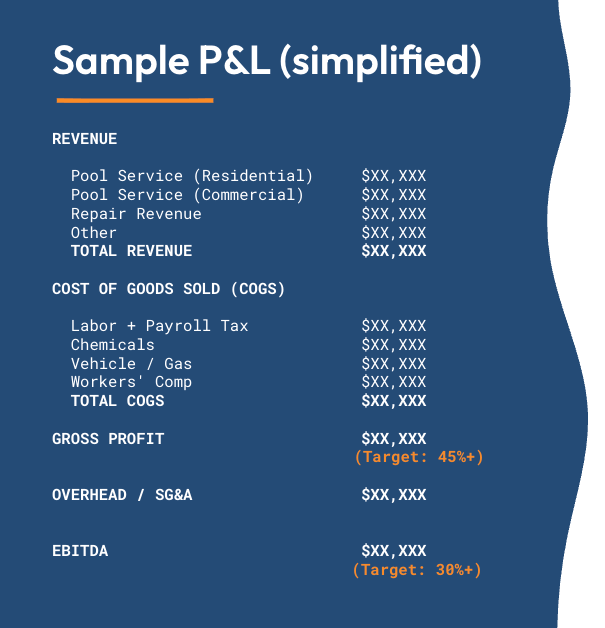
"EBITDA is arguably one of the most important numbers for your business," he said. For a service-oriented operation, Ryan targets a gross profit margin of 45–55% and an EBITDA margin of 20% or better. Those aren't aspirational numbers; they're the benchmarks he bonuses his team against every month.
Move 2: Price your services correctly — and don't be afraid of increases
Underpricing is endemic in this industry. Ryan has acquired routes from operators charging $90 per month for service in a Florida market where rates have meaningfully increased over the past decade. When he raised rates on one acquired book of business, some accounts churned at a rate of roughly 30%. The business still came out ahead on total monthly revenue.
"If you're delivering the value and service you should be, customers aren't going to go anywhere over a small price increase," he said. His advice: if you're hesitant, test a price increase on a subset of your accounts first. Build annual price increases into your spring checklist, communicate them clearly in advance, and train customers to expect them. Operators who do this consistently don't regret it.
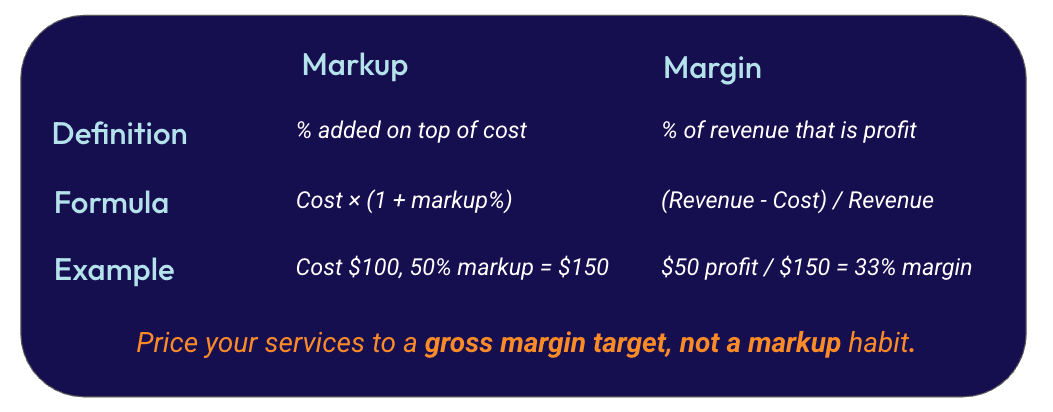
One nuance worth paying attention to is the difference between markup and margin. If you buy a part for $100 and mark it up 50%, you're selling it for $150 — but your margin is only 33%, not 50%. Ryan discovered his own team was making this mistake on parts and equipment sales. His rule now: mark up parts a minimum of 65% to hit his margin targets. If you're pricing repairs or selling equipment without thinking in margin terms, you're likely leaving money behind.
When customers push back on price, Ryan recommends communicating the full scope of what's included: licensed and insured technicians, consistent scheduling, detailed service reports, water chemistry management, and the expertise that comes with a skilled trade. An "illusion of choice" strategy — offering good/better/best service tiers — can also be effective in price-sensitive markets.
Move 3: Track the KPIs that drive profit
Ryan tracks five KPIs on a weekly basis, reviewing them with his leadership team every week without exception.
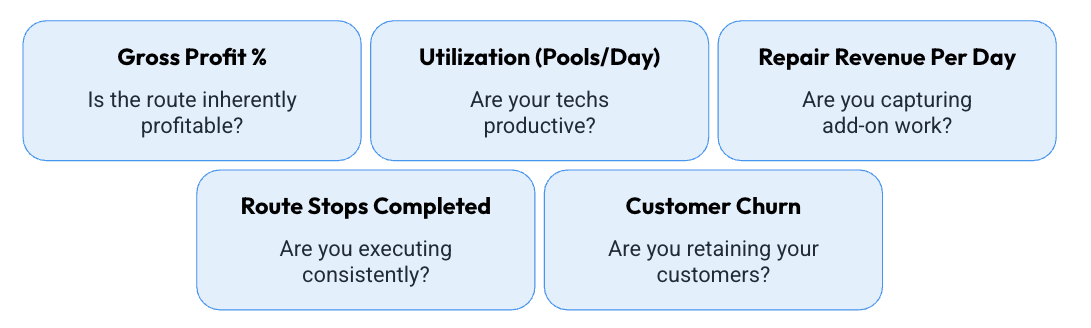
Technician utilization. Based on output from Skimmer's labor report, Ryan measures how many pools each tech is cleaning per day and per week against a target of 15 pools per day (75 per week). This tells him whether he's fully utilizing his team, whether anyone needs coaching, and whether it's time to hire.
Gross profit margin. As discussed above, this is both a business health metric and the basis for team bonuses. When the company hits 45% gross margin, 50% of every dollar above that threshold goes to the team. The other 50% stays in the business.
Repair revenue per day. For businesses with a dedicated repair tech, this is a critical number. A repair technician who isn't fully utilized is a drag on the P&L, because the fixed cost of their labor still hits the books regardless of output. Ryan recommends tracking daily revenue generated per repair tech against the margin that tech is producing.
Route stops completed. A direct indicator of business scale and a key input into utilization calculations.
Customer churn. How many customers are leaving, why, and which technician is associated with that churn. This surfaces service quality issues early and helps retention efforts stay proactive rather than reactive.
The discipline of measuring these numbers matters as much as the numbers themselves. As Joe Shiraz, Skimmer's Director of Product Marketing, noted: just the act of tracking something tends to improve it. Pick a few KPIs, watch them consistently, and the business will start to self-correct.
Move 4: Protect your margins and make sure profits hit the bank
Revenue and margin on paper mean nothing if cash isn't landing in your account. Ryan was candid about this: at 70 pools, a few late payers are a manageable inconvenience. At 1,000+ pools, it becomes a real financial risk without the right systems in place.
A few tools and practices he relies on:
Autopay. Pool service is a recurring monthly service, and it should be billed like one. Putting customers on autopay eliminates the time spent chasing payments and dramatically reduces the accounts receivable backlog.
Account suspension. Skimmer recently released a feature that automatically suspends service for non-paying customers and notifies them each time a scheduled visit is skipped. Ryan said it cleared up outstanding non-payers within two weeks of turning it on. Suspension is fully reversible: the moment a customer pays, service reinstates automatically.
Surcharging. In states where it's legally permitted, passing credit card processing fees to the customer as a surcharge can meaningfully reduce operating costs. Ryan estimated saving at least $4,000 in credit card fees after enabling compliant surcharging. Pushback from customers was minimal — he said fewer than five accounts complained when the surcharge went live across roughly 1,000 customers.
Chemical cost tracking. Outside of labor, chemicals are the largest direct cost. Ryan cross-checks chemical deliveries against what's actually been dosed in the system on a monthly basis. Any significant discrepancy gets investigated.
Move 5: Grow revenue from customers you already have
New customer acquisition is expensive. Revenue from existing customers is not. Ryan runs an annual bulk filter promotion where he negotiates volume pricing from his suppliers (in one case cutting his cost by approximately 50%) and sends a quote to his entire customer base. At a sell price of $95 per filter element across 1,000 customers, even a 50% conversion rate represents meaningful revenue, all at margin.
The same model applies to pressure gauges, skimmer baskets, and other maintenance items that degrade over time and need periodic replacement. The key is systematizing it: create a repeatable annual campaign, time it to the pre-season window, and use your customer communication tools to blast it out efficiently.
Service agreements are another underleveraged revenue protection tool. Ryan sends every new customer a formal quote through Skimmer that doubles as a terms of service document. The link to the full terms appears in the footer of every service report the customer receives. When he rolled out surcharging, he updated the terms accordingly — and customers had already been made aware of them through every service touchpoint.
The pattern underneath all five moves
Looking across all five areas, the common thread is intentionality. Ryan's business is profitable not because Florida is an easy market (it's actually one of the most competitive in the country) but because he runs it with the same financial discipline he applied in investment banking. He knows his numbers, sets targets, measures performance against them, and pays his team when those targets are hit.
For operators who feel like they're working hard without seeing it in their bank account, the answer is rarely to work harder. It's to spend a few hours before busy season kicks in and do the math. Build the break-even model. Set a margin target. Pick two or three KPIs and start tracking them. The pre-season window is short. Use it.
.jpg)


