


FAQs
What does "quote-to-cash" mean for a pool service business?
Quote-to-cash refers to the full sequence of steps between when a customer asks for a price and when payment lands in your account. For pool pros, that includes the quoting step, job approval, scheduling, field work, chemical and parts documentation, invoicing, and payment collection. Problems anywhere in that sequence affect when, and whether, you get paid.
How do I know if my quoting process has gaps?
A useful test: could a different person on your team run a quote start to finish, the same way you would, using your current process? If the answer is no, or if quotes regularly require follow-up conversations before a customer says yes, there are gaps worth examining.
Why does a deposit matter for equipment installs and larger repairs?
A deposit does two things. It protects cash flow by ensuring some payment is collected before labor and materials are committed. It also functions as a filter, because customers who aren't serious about proceeding are less likely to put money down. For any job where materials need to be ordered or significant time blocked, a deposit reduces the financial exposure if the job falls apart.
What's a reasonable billing lag to aim for?
For completed service visits, same-day or next-day invoicing is achievable with the right workflow. For larger jobs, invoicing within 24 to 48 hours of completion is a reasonable target. The first step is measuring your current lag, because most operators don't know what it is until they track it.
What's the most common reason pool pros don't offer autopay?
The most common answer is that it was never set up as a standard part of onboarding new customers. Autopay works best when it's the expected default for recurring service customers, not an option that gets mentioned occasionally. If your current process doesn't include asking every recurring customer to set up autopay, that's a straightforward process change with meaningful cash flow impact.
Do I need software to fix these problems?
Some of these gaps can be addressed with more consistent manual processes. That said, the handoffs that require the most discipline to maintain, such as field documentation flowing automatically into invoices, or automated AR reminders going out on schedule, are substantially easier to manage in purpose-built software. The questions in this post are worth answering regardless of your current tools.
Key takeaways
- Revenue problems in pool service businesses are more often process problems than people problems. The handoffs between quoting, scheduling, field work, invoicing, and collections are where margin quietly disappears.
- A consistent quoting process is the foundation. Verbal estimates that never get documented, approved, or followed up on are a reliable source of lost revenue.
- Deposits serve two functions: protecting cash flow and filtering out low-commitment customers before labor and materials are committed to a job.
- Manual data transfer between systems, whether from field notes to invoices or from approved quotes to job orders, introduces delay and error at every step. The fewer manual steps in a workflow, the fewer opportunities for something to fall through.
- Billing lag is a measurable problem with a measurable cost. Most operators don't know how long it takes them to go from job completion to invoice sent. That number is worth knowing.
- Autopay is the highest-leverage change available for predictable monthly cash flow in a recurring service business. Customers on autopay require no reminders, no follow-up, and no collections friction.
- Proactive AR management requires a system, not a reflex. Waiting until cash gets tight to check on overdue invoices is reactive by definition, and costly by outcome.
##TOC##
##Key takeaways##
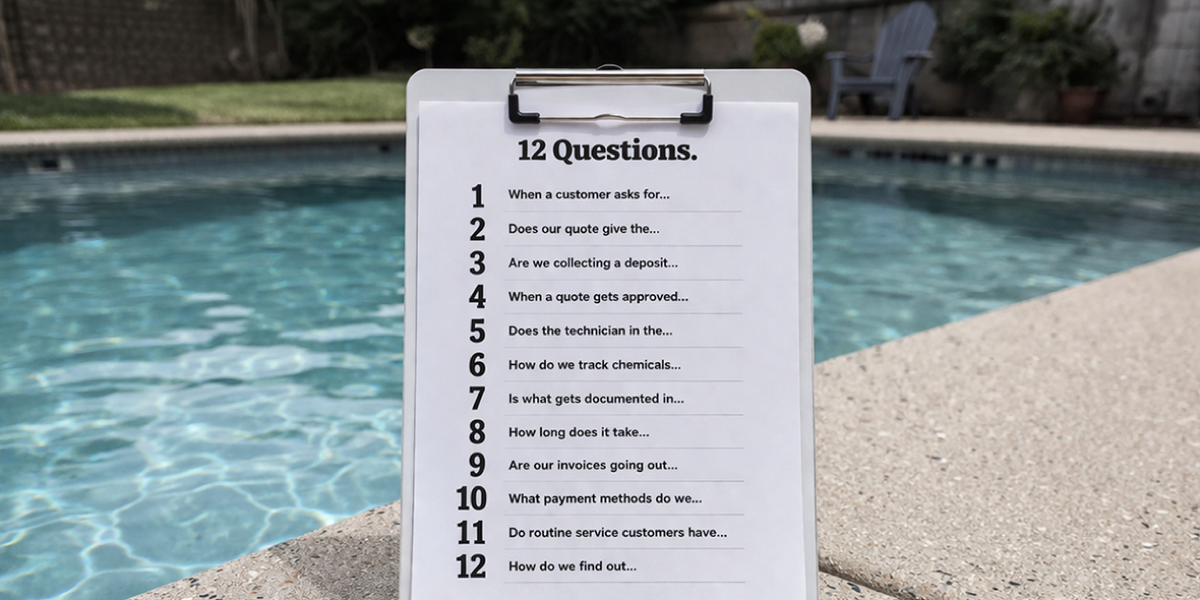
Most revenue problems in a pool service business aren't caused by bad customers or slow payers. They're caused by process gaps that nobody ever stopped to examine. Asking the right questions about how your business moves from quote to cash — before a job goes sideways — is how you find those gaps and close them. These questions are worth working through whether you're a solo operator trying to get more organized or a growing company with a team in the field.
Quoting
1. When a customer asks for a price, what happens next? Is it consistent every single time?
There's a difference between giving someone a number and actually quoting a job. If your quoting step is more of a reflex than a real process, you're likely losing revenue to verbal estimates that never get documented, approved, or followed up on. The goal is a repeatable step that happens the same way every time, for every customer.
2. Does our quote give the customer everything they need to say yes on the spot?
A quote that requires three follow-up conversations before a customer commits is a quote that isn't doing its job. Itemized scope, photos, clear pricing, and a professional presentation all reduce the back-and-forth that delays approval — and delays the cash that follows.
3. Are we collecting a deposit at approval? If not, what's stopping us?
This question is worth sitting with. If the answer is "we never really set that up," that's a fixable problem. If the answer is "customers don't like it," that's worth examining more carefully.
Why this question matters more than most
A deposit does more than protect cash flow — it filters out low-commitment customers before you've spent labor and materials on a job that falls apart. For equipment installs and larger repairs, a deposit should be non-negotiable. If your current process doesn't include one, that's where the conversation starts.
Handoff and scheduling
4. When a quote gets approved, how does that information get to the person doing the work?
Re-keying data, forwarding emails, and verbal handoffs are where scope gets lost and mistakes get made. The right answer is that an approved quote converts to a job automatically, with no manual transfer required. If that's not how your process works today, you've identified a gap worth closing.
5. Does the technician in the field know exactly what was quoted and what's included before they arrive?
Field teams operating without full context leads to under-delivery, scope disputes, and awkward conversations with customers who were expecting something different. Everything agreed to at the quote stage should be visible to the tech before they pull into the driveway.
Completing the work and capturing billables
6. How do we track chemicals used, parts installed, and add-on work performed at every stop?
If the honest answer is "we try to remember" or "we write it on a notepad," there's money leaving the business on every single route. Every unbilled chemical and untracked add-on is margin that never makes it to an invoice.
7. Is what gets documented in the field automatically reflected in the invoice, or does someone have to manually transfer that information?
Manual data entry between field documentation and invoicing introduces errors and, more commonly, delay. Every extra step between "work completed" and "invoice sent" is an opportunity for something to fall through the cracks.
Invoicing
8. How long does it take from job completion to invoice sent?
Most operators don't have a clear answer to this question. Before you can improve your invoicing speed, you need to measure it. If your billing lag is two days, that's a target. If it's two weeks, that's a problem with a cost attached to it.
9. Are our invoices going out with clear payment terms, or are customers left guessing when something is due?
"Net 30" buried in a footer is not clear payment terms. If a customer has to wonder when their invoice is due, you've introduced friction that slows collection. Explicit terms, stated plainly, are one of the most straightforward and most overlooked levers for faster payment.
Payment collection
10. What payment methods do we actually offer, and are we making it easy or hard for customers to pay?
Checks, cash, and "call the office" are friction. Modern customers expect to pay online, with a card, without a phone call. The easier you make it to pay, the faster you get paid. That's not a theory — it's a pattern that shows up consistently across service businesses.
11. Do routine service customers have autopay set up? If not, are we actively asking them to?
Autopay is the single highest-leverage change available to a pool service business for predictable monthly cash flow. A customer on autopay doesn't require a reminder, a follow-up, or a collections conversation. If you have recurring customers who aren't on autopay, you're managing collections work that doesn't need to exist.
Visibility and follow-up
12. How do we find out about overdue invoices? Do we have a system, or do we notice when cash gets tight?
Reactive AR management means you're always one slow month away from a cash flow problem. Proactive AR management means automated reminders go out on a schedule, aged receivables are visible before they become urgent, and nothing slips through because someone forgot to check.
What to actually do about it: closing the gaps in your revenue workflow
None of these questions require a process overhaul to answer. They require honesty. The businesses that collect faster and chase less aren't necessarily bigger or better resourced. But they have examined each handoff in their revenue workflow and closed the gaps.
If you've identified gaps, here's what addressing them actually looks like in practice.
Write everything down and get a formal approval
If your quoting step is verbal, start there. A written quote with itemized scope, pricing, and photos gives both parties a shared record before any work begins. The approval step matters too: a documented sign-off (not a text confirmation) is the difference between a clear agreement and a memory contest if something is questioned later. For equipment installs and larger repair jobs, collect a deposit at approval. It protects cash flow before labor and materials are committed and filters out customers who weren't serious about moving forward.
Document field work in real time
The only reliable way to bill for everything that was done is to capture it at the stop, not reconstruct it later. Techs logging chemicals used, parts installed, and add-on work from a mobile device at each stop eliminates the gap between what was done and what makes it onto the invoice. It also creates a record that exists if a customer ever disputes whether a repair was made or a chemical was applied.
Connect your quote to your job
When quoting and job management live in separate systems, the handoff requires manual re-entry. Details get abbreviated, line items get dropped, and the tech in the field often doesn't have full context on what was sold. When those two things live in the same system, an approved quote converts directly to a scheduled job with scope, photos, and customer notes intact. The work that was sold is the work that gets done. For larger repair projects — where that handoff also involves a deposit, a multi-day schedule, and a final invoice that needs to match the original scope — see how that system works for bigger repair projects.
Invoice the same day the work is completed
Billing lag is a choice, even if it doesn't feel like one. Invoices built directly from job line items can be generated and delivered the same day work is completed, with no reconstruction required. Any deposit collected at quote approval should apply automatically to the final balance so the customer receives an accurate invoice without a follow-up conversation. Same-day invoicing shortens the payment cycle and reduces the chance that add-ons or extras get left off.
Remove friction from the payment step
Customers who can pay online, with a card, without a phone call pay faster than customers who can't. Autopay for recurring service customers removes collection from the equation entirely: the charge runs on schedule, no action required from either side. Card on file for one-time and repair jobs applies the same principle at job completion. For customers who prefer other methods, logging those payments in the same system keeps the record clean.
Set up visibility before you need it
Overdue accounts don't announce themselves. Automated overdue reminders send a professional touchpoint to customers with an outstanding balance without requiring a staff member to make individual calls. Aged receivables reporting surfaces which accounts have slipped past 30, 60, or 90 days so the problem is caught before it becomes a cash flow issue. Auto-suspend policies for persistent non-payers remove the uncomfortable judgment call: the rule is set once and applied consistently.
None of these are dramatic process overhauls. Each one closes a specific gap in the workflow between when work is agreed on and when payment arrives. The businesses with predictable cash flow aren't necessarily larger or better staffed, they've built a tighter system around getting paid for the work they do.
If you want to learn more about how Skimmer can help you manage your whole quote to cash process, book a demo with us now or dive right in and try it free for 30 days.


